
Why Starting a Task Feels So Hard (And How to Make It Easier)
Have you ever sat down to work on something important, only to find yourself checking your phone, organizing your desk, or watching “just one quick video” instead?
The strange part is that you actually want to complete the task. You know it’s important. You may even feel guilty for avoiding it. Yet somehow, getting started feels almost impossible.
Most people blame this on laziness or a lack of discipline. But psychology tells a different story.
The real problem isn’t that you don’t want to work. It’s that your brain believes the cost of starting is higher than the immediate reward.
Understanding this simple idea changes everything. Instead of trying to force yourself to work through sheer willpower, you can learn how to reduce the mental resistance that makes starting feel so difficult.
Your Brain Isn’t Fighting the Task—It’s Predicting the Cost
Before you begin any task, your brain performs a quick mental calculation.
Without you even realizing it, it asks questions like:
- How difficult will this be?
- How long will it take?
- What if I fail?
- Do I even know where to begin?
- Is there something easier or more enjoyable I could do instead?
If the answers are uncertain, your brain often decides that postponing the task is the safer option.
This isn’t a character flaw. It’s an efficiency strategy.
For thousands of years, conserving energy helped humans survive. Our brains evolved to avoid unnecessary effort whenever possible. The problem is that modern work—writing reports, studying, building businesses, or learning new skills—doesn’t always provide immediate rewards.
As a result, your brain often mistakes productive work for unnecessary effort.
The Real Problem Is Mental Resistance
Most people think difficult tasks are hard because they require a lot of work.
In reality, many tasks feel difficult because they require a lot of mental activation before the work even begins.
Think about writing a research paper.
Before typing the first sentence, you might wonder:
- What should I write first?
- Is this a good idea?
- What if it isn’t good enough?
- How should I structure it?
Notice something?
None of these thoughts are actually part of writing.
They’re simply preventing you from starting.
Your brain often confuses uncertainty with difficulty.
The less clear a task feels, the more exhausting it appears.
Why Starting Is Harder Than Continuing
Have you ever noticed that once you’ve worked for fifteen or twenty minutes, continuing suddenly feels much easier?
That’s because the hardest part isn’t usually the work itself.
It’s switching from thinking about working to actually working.
Before starting, your brain has to:
- Make decisions
- Ignore distractions
- Resist easier alternatives
- Overcome uncertainty
Once you’re engaged, those mental costs drop significantly.
Psychologists sometimes refer to this as overcoming the activation barrier. After crossing that barrier, momentum begins to build naturally.
This is why the first ten minutes often feel much harder than the next hour.
The Four Hidden Sources of Starting Friction
Not every task feels difficult for the same reason.
Most resistance comes from one or more of these four hidden obstacles.
1. Lack of Clarity
Your brain dislikes ambiguity.
If your to-do list says:
“Work on project.”
Your mind has no idea what that actually means.
But if it says:
- Open the project file.
- Write three possible headlines.
- Outline the introduction.
Suddenly, the task becomes manageable.
The clearer the next step, the lower the mental resistance.
2. Fear of Imperfection
Many people don’t procrastinate because they’re lazy.
They procrastinate because they believe their first attempt has to be good.
Perfection creates enormous pressure.
Your brain interprets that pressure as risk.
Instead of risking failure, it chooses avoidance.
Ironically, lowering your standards for the first draft often increases productivity.
Remember:
Your first version doesn’t need to be impressive. It only needs to exist.
Progress almost always comes before perfection.
3. Decision Overload
Every decision consumes mental energy.
If you sit down to work without knowing:
- what to do,
- where to start,
- how long you’ll work,
- or what success looks like,
your brain spends most of its energy making decisions instead of taking action.
Highly productive people reduce decision-making whenever possible.
That’s why many writers use templates.
Why athletes follow routines.
Why successful entrepreneurs rely on systems instead of daily motivation.
Less deciding means more doing.
4. High Activation Energy
Some tasks require too much preparation before you can even begin.
You may need to:
- Open several applications.
- Find documents.
- Gather notes.
- Clear your workspace.
- Organize your thoughts.
Each additional step creates another opportunity to procrastinate.
Think of it like pushing a heavy boulder.
The hardest part isn’t keeping it moving.
It’s getting it moving in the first place.
The more preparation a task requires, the more activation energy it demands.
The Friction Reduction Framework
Instead of trying to increase motivation, focus on reducing friction.
Small changes in how you approach a task can dramatically increase the likelihood that you’ll actually begin.
Here is a simple four-step framework.
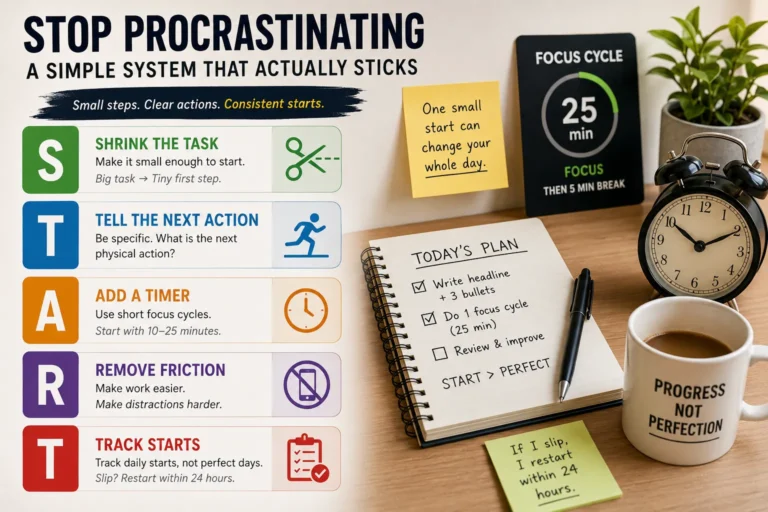
Step 1: Clarify the Next Action
Don’t write:
Finish presentation.
Write:
- Open PowerPoint.
- Create the title slide.
- Write three bullet points.
Your brain works better with actions than with vague objectives.
Specificity removes uncertainty.
Step 2: Shrink the Task
Large projects intimidate the brain.
Small actions don’t.
Instead of saying:
“I’m going to write an entire article.”
Tell yourself:
“I’m only writing the introduction.”
Or:
“I’m going to work for five minutes.”
Once you’ve started, continuing usually becomes much easier because momentum begins replacing resistance.
Step 3: Prepare Your Environment
Ask yourself:
“What can I do now that will make starting easier later?”
Maybe it’s:
- Closing unnecessary tabs.
- Charging your laptop.
- Placing your notebook on your desk.
- Turning off notifications.
- Preparing tomorrow’s workspace before leaving today.
Reducing physical friction often reduces mental friction as well.
Step 4: Start Before You Feel Ready
Many people believe motivation comes first.
It usually doesn’t.
Action creates motivation far more often than motivation creates action.
Waiting until you “feel like it” can keep you stuck for days.
Starting—even imperfectly—changes your mental state.
Once your brain recognizes that progress has begun, continuing becomes much easier.
A Simple 10-Minute Starting Ritual
Whenever you feel stuck, try this routine.
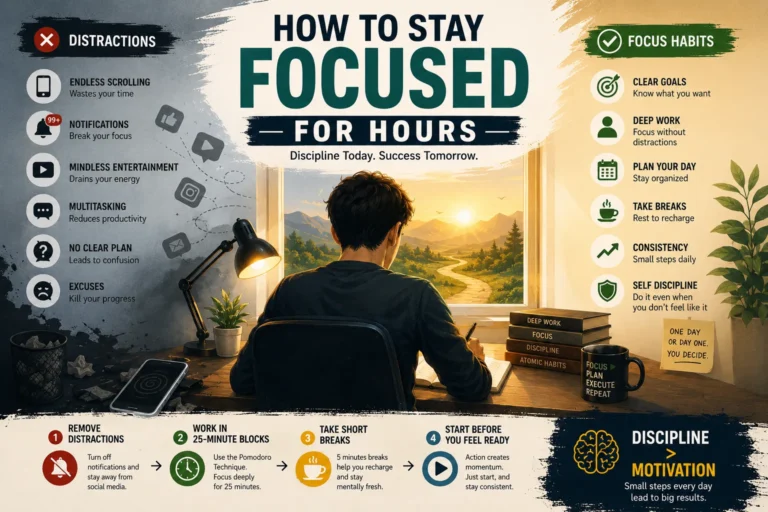
Minute 1: Eliminate distractions.
Put your phone away.
Close unnecessary tabs.
Silence notifications.
Minute 2: Define one clear next action.
Not the whole project.
Just the next step.
Minutes 3–5: Prepare everything you need.
Gather your materials.
Open the necessary files.
Create a clean workspace.
Minutes 6–10: Work without judging your progress.
Don’t worry about quality.
Don’t think about finishing.
Focus only on moving forward.
At the end of ten minutes, ask yourself:
“Do I want to continue?”
Most of the time, the answer will be yes.
Because you’ve already overcome the hardest part: starting.
Final Thoughts
Productivity isn’t simply about having more discipline.
It’s about understanding how your brain works.
If starting feels difficult, don’t immediately assume you’re lazy or unmotivated.
Instead, ask yourself:
- Is the task unclear?
- Am I trying to be perfect?
- Am I making too many decisions?
- Is there too much friction before I even begin?
When you reduce resistance instead of forcing motivation, starting becomes dramatically easier.
Remember:
You don’t need a stronger mind.
You need an easier beginning.
Every meaningful achievement starts with one small action.
Make that first action as simple as possible, and let momentum do the rest.
Frequently Asked Questions
Why does starting a task feel harder than doing it?
Because your brain must overcome uncertainty, make decisions, and resist distractions before entering a focused state. Once you begin, those mental costs decrease significantly.
Is procrastination always caused by laziness?
No. Procrastination is often caused by mental resistance, uncertainty, perfectionism, or decision overload rather than a lack of motivation.
What’s the fastest way to start a difficult task?
Reduce friction by defining one small, clear action and committing to just five or ten minutes of focused work.
Why do small tasks help me stay productive?
Small tasks reduce psychological resistance, making it easier for your brain to begin. Once you start, momentum naturally builds.
Should I wait until I feel motivated?
No. Motivation often follows action—not the other way around. Starting first is usually the fastest way to create motivation.

Founder of MindSpaceGlow — I write about intentional living, mindset & productivity for a calmer life. Not a licensed therapist, but sharing practical, research-based tools that work in real life.
More about me →