How to Stay Focused for Hours
The Real Reason Your Attention Keeps Collapsing — And How to Rebuild Deep Focus in a Distracted World
Meta Description
Struggling to stay focused for long periods? Discover the psychology behind distraction, dopamine, procrastination, and mental fatigue — plus practical strategies to train deep focus and improve productivity naturally.
Focus Is Not Just About Productivity Anymore
It’s about survival.
Most people today are not physically exhausted.
They’re mentally fragmented.
Their attention is constantly interrupted.
Their brain never fully rests.
And even simple tasks now feel strangely difficult to sustain.
That’s why so many people sit down to work… then immediately feel the urge to:
- check notifications
- open social media
- watch something quickly
- switch tasks
- escape discomfort
Not because they’re lazy.
Because their nervous system has been trained to avoid stillness.
And this is the hidden crisis most people don’t recognize:
The modern world is quietly destroying the ability to focus deeply.
Your Brain Is Addicted to Stimulation, Not Progress
This is where most focus problems actually begin.
The brain naturally chases dopamine — the neurotransmitter connected to anticipation, novelty, and reward.
Every time you:
- refresh your phone
- watch short videos
- switch between apps
- consume fast content
your brain receives tiny bursts of stimulation.
Over time, this rewires attention.
Slow activities start feeling emotionally “heavy” compared to rapid digital rewards.
That’s why reading for 20 minutes feels harder than scrolling for two hours.
Not because reading is difficult.
Because your brain has adapted to constant novelty.
The scary part?
Most people don’t notice this happening gradually.
They simply assume they “lost motivation.”
The Real Enemy of Focus Is Emotional Resistance
People often think focus is purely about discipline.
But psychologically, focus is deeply emotional.
When a task feels:
- uncertain
- overwhelming
- mentally demanding
- boring
- emotionally uncomfortable
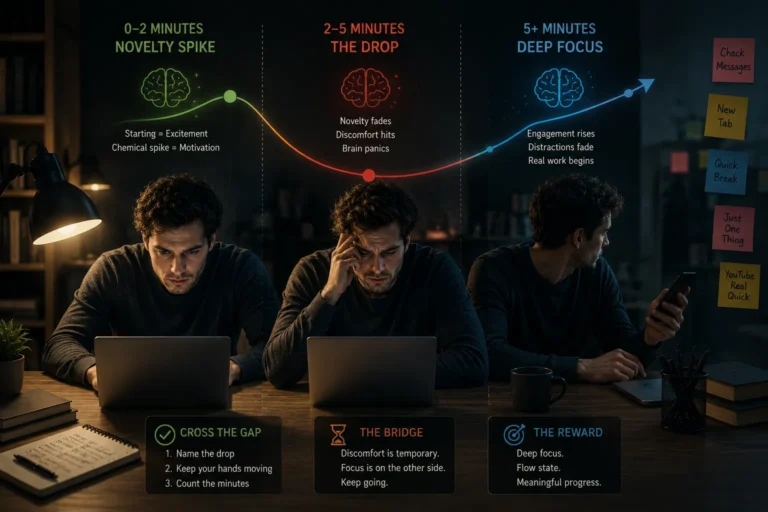
the brain instinctively searches for escape.
Distraction becomes emotional relief.
That’s why people suddenly feel the urge to clean their room, check messages, or open YouTube right before important work.
The brain is not trying to help you succeed.
It’s trying to reduce discomfort as quickly as possible.
And unfortunately, modern technology offers endless escape routes.
Why Most People Can’t Focus for More Than a Few Minutes
Attention works like a muscle.
But most people train distraction all day long.
Think about the average daily behavior:
- checking the phone every few minutes
- multitasking constantly
- consuming fragmented content
- reacting to notifications instantly
This conditions the brain to expect interruption.
Deep focus then starts feeling unnatural.
And here’s the important part:
The issue is not intelligence.
It’s attention conditioning.
You cannot spend years training distraction and suddenly expect effortless concentration.
Focus must be rebuilt deliberately.
Motivation Is Unreliable — Systems Matter More
One of the biggest productivity mistakes is waiting to “feel focused.”
That rarely works consistently.
High performers do not depend on emotional readiness every day.
They reduce friction instead.
Small environmental changes often create massive improvements:
- putting the phone in another room
- blocking distracting apps
- working in silence
- using timed focus sessions
- creating predictable routines
This matters because behavior is heavily influenced by environment.
Willpower alone eventually collapses under constant temptation.
Systems protect attention when motivation disappears.
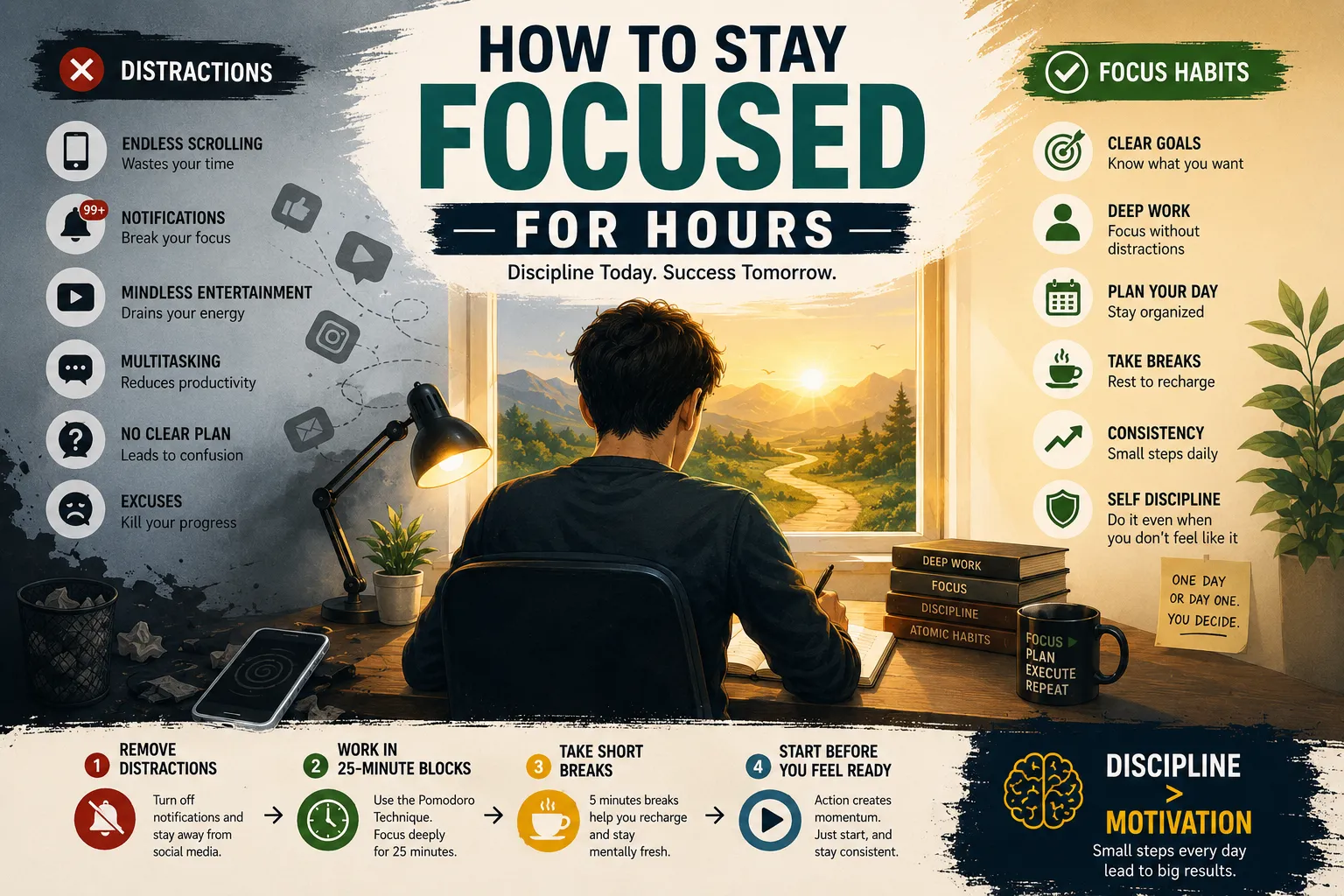
The 25-Minute Rule Works Because of Psychology
The image mentions working in 25-minute blocks.
That approach works for a deeper reason than most people realize.
The brain resists large undefined effort.
But shorter focus windows feel psychologically safer.
When you tell yourself:
“I only need to focus for 25 minutes.”
the task suddenly feels manageable.
Resistance decreases.
Starting becomes easier.
And starting is often the hardest part.
Interestingly, once focus begins, the brain frequently continues beyond the original time block naturally.
Momentum changes mental state.
Mental Fatigue Is Often Hidden Decision Fatigue
Many people believe they lack energy.
In reality, they’re overloaded by constant micro-decisions.
Every notification…
Every app switch…
Every interruption…
Consumes cognitive energy.
The brain becomes mentally cluttered before meaningful work even begins.
This is why deep work feels easier in quiet environments with fewer choices.
Simplicity protects mental clarity.
The fewer unnecessary inputs your brain processes, the more energy remains for meaningful focus.
Deep Focus Requires Boredom Again
This part makes people uncomfortable.
But it’s true.
You cannot rebuild attention while constantly overstimulating yourself.
The brain needs moments of silence.
Moments without entertainment.
Without scrolling.
Without stimulation.
At first, boredom feels unbearable because the nervous system expects constant dopamine.
But over time, something important happens:
Your baseline attention stabilizes.
Simple activities regain depth.
Reading becomes easier.
Thinking becomes clearer.
Work stops feeling painfully slow.
Focus returns gradually when overstimulation decreases.
Discipline Is More Powerful Than Motivation
Motivation is emotional.
Discipline is structural.
Motivation changes daily depending on:
- mood
- sleep
- stress
- emotions
- environment
Discipline removes negotiation.
You stop asking:
“Do I feel like doing this?”
And start acting from identity instead.
This shift changes everything psychologically.
Because consistent action builds self-trust.
And self-trust reduces internal resistance over time.
How to Train Yourself to Focus for Hours
Not through hacks.
Not through extreme routines.
But through rebuilding your relationship with attention itself.
1. Remove stimulation before starting work
Don’t enter focused work already mentally overloaded.
Silence notifications.
Close unnecessary tabs.
Reduce inputs.
2. Use short focus blocks initially
Train concentration gradually.
Focus is endurance training for the brain.
3. Stop multitasking completely
Multitasking destroys cognitive depth.
Your brain performs better when fully engaged in one task.
4. Protect your mornings
The first hour of your day often determines the quality of your attention afterward.
Avoid instant stimulation early.
5. Learn to tolerate discomfort
Focus feels uncomfortable at first because your brain is withdrawing from constant novelty.
That discomfort is normal.
Stay anyway.
The Ability to Focus Is Becoming a Competitive Advantage
Most people are losing the ability to think deeply.
Which means deep focus is becoming increasingly rare.
And rare skills become valuable.
The people who can sit quietly, think clearly, and work without constant distraction will have a massive advantage — professionally, mentally, and emotionally.
Because focus is no longer just about getting work done.
It shapes:
- creativity
- learning
- emotional stability
- decision-making
- confidence
- self-respect
Attention determines the quality of your life more than most people realize.
And every day, you are either training focus…
or training distraction.

Founder of MindSpaceGlow — I write about intentional living, mindset & productivity for a calmer life. Not a licensed therapist, but sharing practical, research-based tools that work in real life.
More about me →