Reclaiming Your Attention: How to Defeat Digital Distraction and Protect Your Focus
Every morning, millions of people execute the exact same unconscious ritual. Within seconds of opening their eyes, before they have even greeted the day or fully processed their thoughts, they reach for their smartphones. They open email inboxes, scan news headlines, and lose themselves in algorithmically curated social media feeds. Before their feet have even touched the floor, their minds have been flooded with the opinions, emergencies, and lifestyles of thousands of strangers.
Your attention is the most valuable asset you own. It is the fuel that drives your career, your personal growth, and your creative potential. Yet, in our modern world, your attention is constantly being sold to the highest bidder. We live in a highly sophisticated attention economy where some of the world’s most intelligent software engineers use advanced behavioral psychology to keep your eyes locked on a screen.
When you spend your days constantly reacting to notifications, checking open browser tabs, and indulging in short-form videos, you are not just wasting time. You are actively destroying your capacity for sustained mental effort. This guide will explore the hidden mechanics of digital distraction, explain why your brain feels constantly busy yet unproductive, and provide a practical framework to defeat digital noise and reclaim your deep focus.
1. The Attention Residue: Why Infinite Tabs Drain Your Brain
Many people believe they are excellent at multitasking. They boast about their ability to write an article while answering chat messages, monitoring an inbox, and listening to a podcast. However, cognitive psychology reveals a brutal truth: the human brain cannot consciously process two cognitively demanding tasks simultaneously.
When you think you are multitasking, what your brain is actually doing is “task-switching.” It is rapidly bouncing its focus from one target to another. Every single time you switch your attention—even for a split second to look at a text message—you pay an expensive cognitive tax known as Attention Residue.
[ TASK A: DEEP WORK ] ──> [ QUICK PHONE CHECK ] ──> [ RETURN TO TASK A ]
                                 │                           │
                                 └───> [ ATTENTION RESIDUE RECOVERS SLOWLY ]
A portion of your working memory remains fixed on the previous disruption. If you check your phone while working on a project, your brain does not immediately return to 100% efficiency when you put the device down. It can take up to 20 minutes of intense concentration to recover from a single distraction and re-enter a state of flow. If you check your phone every ten minutes, you are spending your entire life in a state of chronic cognitive fragmentation. Your brain is running in the background, exhausted by its own chaotic loops.
2. Breaking the Boredom Reflex: The Dopamine Reset
The primary reason we succumb to digital distraction is that we have developed a dangerous “boredom reflex.” Because digital devices offer instant, effortless novelty, our brains have lost the capacity to tolerate even a single moment of quiet or inactivity.
- When waiting in a line, we pull out our phones.
- When a video takes three seconds to load, we open another app.
- When we hit a difficult sentence while writing, we instinctively check an inbox.
This constant avoidance of boredom rewires your neural pathways. Your brain becomes addicted to high-stimulation environments. To break this addiction, you must practice a systematic dopamine reset. You must teach your brain that boredom is not an emergency that needs to be fixed with a screen; it is a necessary space where creativity, focus, and mental clarity are born.
3. The Digital Detox Protocol for High-Performers
To protect your cognitive boundaries, you cannot rely on vague promises to “use your phone less.” You must design a strict, friction-based protocol that manages your technology for you.
Step 1: The Out-of-Sight Environment
As long as your smartphone rests on your desk or within your peripheral vision, it is actively draining your willpower. Studies show that the mere physical presence of a smartphone reduces available cognitive capacity because your brain must exert subconscious energy to ignore it.
- The Action: During your dedicated deep work blocks, place your phone on silent mode in a completely separate room or lock it inside a drawer. If you must keep it in the room for emergencies, use applications that completely block social media and entertainment platforms during working hours.
Step 2: The Grayscale Shift
Technology companies use vibrant, warm colors—especially bright reds and oranges for notification badges—to trigger your brain’s evolutionary threat and reward systems. Your phone is visually designed to look like a tray of colorful candy.
- The Action: Go into your device’s accessibility settings and change your display filter to Grayscale. Removing the color instantly strips the device of its psychological appeal. Social feeds look dull, notifications lose their urgency, and your brain naturally spends less time seeking novelty from a grey screen.
Step 3: Intentional Consumption Blocks
Answering emails and communication messages is part of modern work, but doing it reactively throughout the day destroys your concentration.
- The Action: Transition from a reactive communication style to an intentional one. Set two or three specific time-blocks during your day dedicated solely to answering messages (e.g., 11:00 AM and 4:00 PM). Outside of these blocks, keep your communication tools completely closed. Treat your inbox as a task to be executed, not a master that dictates your day.
4. Systems Over Chaos: Visualizing Your Time
| Daily Structure | Distracted Lifestyle (Reactive) | Disciplined Lifestyle (Intentional) |
| Morning Entry | Checks notifications immediately upon waking. | Follows a structured morning routine without screens. |
| Workspace Design | Multi-tab browsing, phone on desk, high noise. | Clean workspace, phone in another room, single-tasking. |
| Time Management | Operates on vague wishes; works when motivated. | Allocates strict, unmovable time-blocks for deep focus. |
Reclaiming your focus is ultimately a battle of environment design. If your digital workspace is a chaotic mess of unorganized files, desktop notifications, and forgotten browser tabs, your mind will naturally mirror that exact chaos.
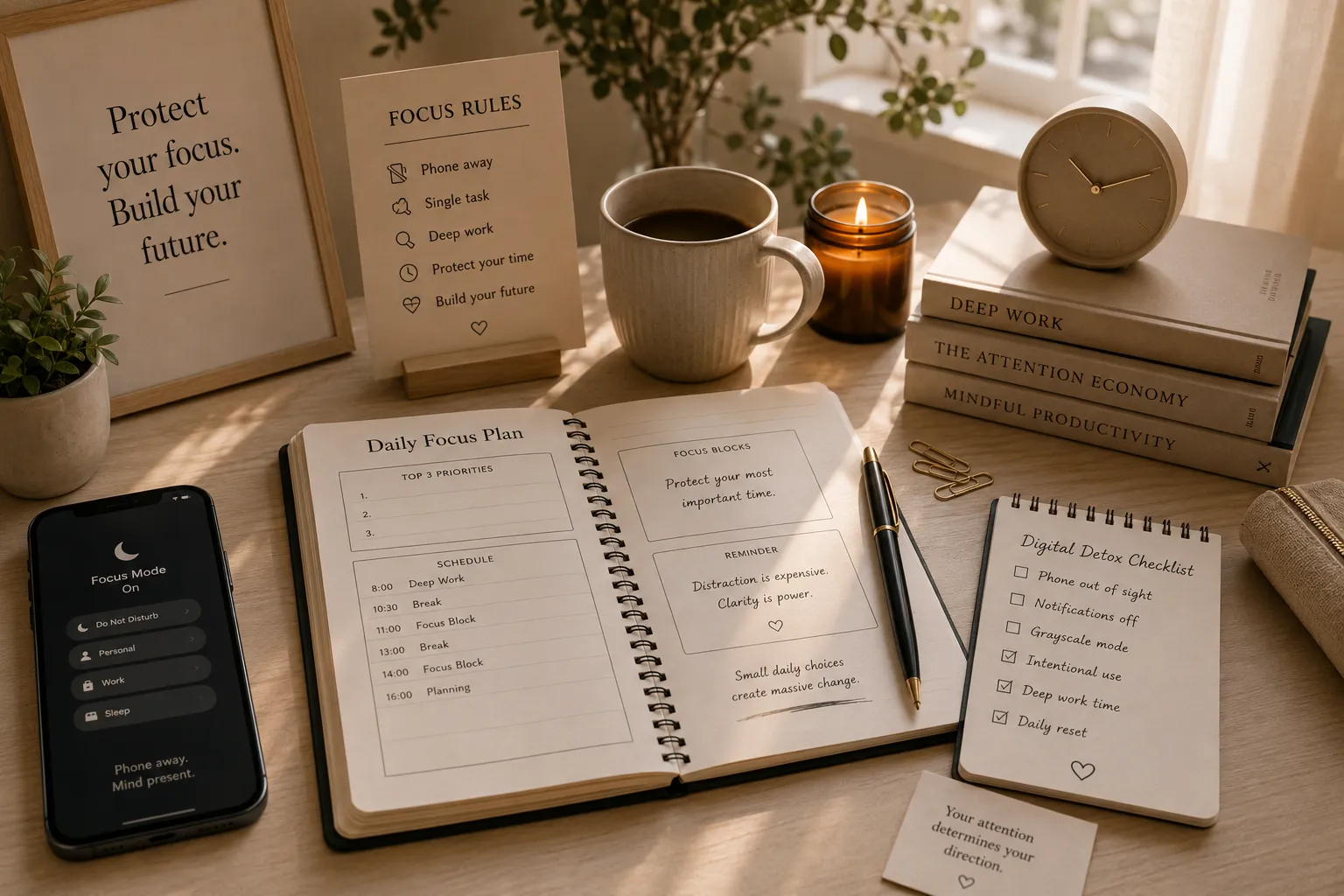
To maintain deep concentration without feeling mentally overwhelmed, you must offload your schedule into a minimalist, clean, and functional system. Utilizing an interactive digital planner, an aesthetic daily framework, or a dedicated time-blocking template transforms how you view your hours. It moves you away from a reactive lifestyle where you constantly answer other people’s emergencies, and shifts you into an intentional lifestyle where your daily choices build your future.
Conclusion: Reclaim Your Future Today
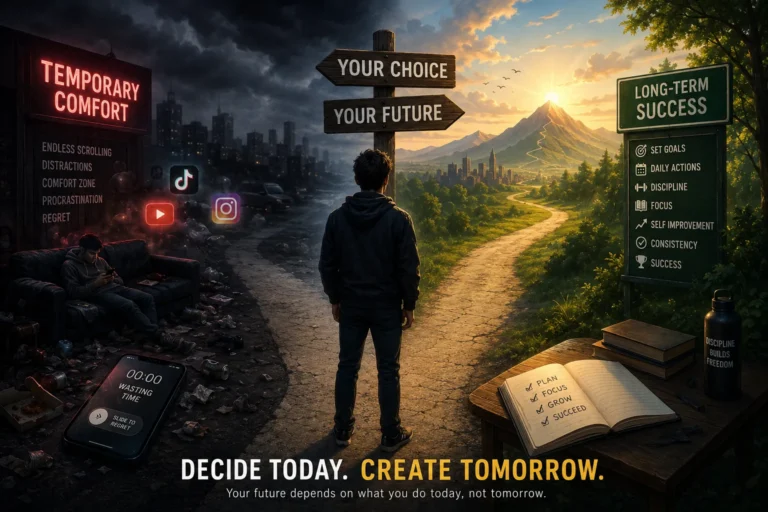
Your future self is built by the tiny, daily choices you make with your attention. When you allow your focus to be fragmented by digital noise, you are allowing outside forces to write your story. But when you build an unshakeable boundary around your mind when you embrace boredom, control your environment, and use premium tools to systemize your days you unlock an elite level of productivity.
Stop allowing your potential to rot in low-dopamine loops. Turn off the noise, put away the phone, and choose what is hard today so your life can be profoundly clear tomorrow.

Founder of MindSpaceGlow — I write about intentional living, mindset & productivity for a calmer life. Not a licensed therapist, but sharing practical, research-based tools that work in real life.
More about me →





One Comment