
The Time Blocking Method: A Practical Guide to Owning Your Day
I used to finish workdays tired and a little annoyed with myself. My to-do list was checked off, sort of. But when I looked back at the hours, I hadn’t actually moved my own work forward. I had spent the whole day reacting. Email, Slack, a quick call, an invoice I forgot, back to the report, another message. Busy all day, nothing deep done.
The problem wasn’t what I was doing. It was when. No one told me when to do anything. So everything floated in this vague “sometime today” space, and the loudest thing always won.
Time blocking fixed that for me, not because it’s fancy, but because it’s stupidly simple. You give each task a home on your calendar.
What it actually is, without the productivity jargon
From 9 to 10:30, I write. From 10:30 to 11, I answer email. From 11 to 12, I meet with my contractor. The block is the unit, not the task list.
This sounds obvious until you notice how rarely anyone actually works like this. A normal day is switching. You start a report, a message pings, you remember you have to send an invoice, you check your inbox to feel productive, then you go back to the report and have to reload the whole thing in your head. Researchers call that a switching cost. The commonly quoted number is it takes over 20 minutes to fully refocus after an interruption. I don’t know if it’s exactly 20 minutes for me, but I know it feels like it.
When I started grouping similar work together, my brain got permission to stay in one mode long enough to finish something. I stopped jumping between shallow and deep work every seven minutes.
Why it works for a brain that gets tired of deciding
Two things drain me every day without me noticing: deciding what to do next, and tasks that have no edges.
Decision fatigue is real. Every time you ask “What should I do now?” you spend a little energy. By 3pm, you have none left, so you do the easy thing, which is check email again. When my day is already blocked the night before, I don’t decide. I glance and start. That one change saved me an hour of dithering in the morning.
The second one is open-endedness. “Work on proposal” has no edges, so it expands to fill your whole afternoon. That’s Parkinson’s Law – work expands to fill the time you give it. “Work on proposal from 1 to 2:30” is a completely different instruction to your brain. It has a start and a stop.
Read More: Your Skin Doesn’t Need More Products
How I built my first day without overcomplicating it
I didn’t buy an app. I used Google Calendar.
First, I dumped everything out of my head. Not organized, just out. Client logo revisions, invoices, groceries, dentist call, reply to Sam, outline for this article. If it’s not on a list you trust, you can’t schedule it. You will just keep remembering it at 11pm.
Then I sorted by energy, not just urgency. My brain is clearest from 9 to 11:30. After lunch, especially 1:30 to 2:30, I’m useless for creative work. So hard, creative stuff goes in the morning. Email, admin, meetings go in the afternoon dip. If you’re the opposite and you do your best thinking at night, put deep work there. Don’t fight your own rhythm.
Then I estimated time, and I was wrong. Everyone is. I thought writing this article would take 90 minutes. It took almost three hours with edits. So now I add 50% to whatever I think. If I think an hour, I block 90 minutes. I also leave buffer between blocks. Ten or fifteen minutes where nothing is scheduled. That buffer is where real life happens.
I block the big rocks first. For me, that’s deep work and non-negotiables. On Tuesdays, that’s two blocks: 9-11 for client design, and 2:30-4 for writing. Once those have a home, I fill the gaps with shallow work. If I do it the other way around, shallow work eats the whole day.
And I protect one block of deep work like it’s a meeting with someone important. One 90-minute window of uninterrupted focus is worth more than four hours of fractured attention. I put my phone in the kitchen, close Slack, and I tell my roommate I am not available. That one block is why I actually finish things now.
Three variations I tried
- Task batching. Instead of answering email 20 times, I answer it twice: 11 to 11:30 and 4 to 4:30. Same with invoicing. Same with Instagram DMs for MindSpaceGlow. Grouping small similar tasks together is less exhausting than sprinkling them all day. This helped me a lot when my inbox was controlling me.
- Theme days. My friend who runs a small bakery in Ottawa does this. Monday is baking and production, Tuesday is admin and orders, Wednesday is marketing. She doesn’t switch identities every hour. I’m not there yet because my freelance work is too mixed, but I do a half-theme: Monday morning is all writing, no client work. It reduces that mental cost of switching between “writer” and “designer.”
- Time boxing is the stricter cousin. Time blocking says “write from 9 to 11.” Time boxing says “write from 9 to 11 and stop at 11 even if it’s not perfect.” I use this when I tend to over-perfect. I set a timer. When it rings, I stop. That urgency kills perfectionism. My first drafts are messier now, but they actually get done.
Where it breaks, and how I fixed it
My first week of time blocking failed by 11am on Monday. I had blocked every minute from 7am to 9pm, no breathing room. First interruption, a client called, and the whole plan collapsed. I felt like I failed and abandoned it by lunch.
Now I only block 60 to 70% of my day. A schedule you can follow beats a perfect one you can’t. Leave white space.
The second failure was treating the calendar like a boss. Real life is messy. A kid gets sick, a client has an emergency, Hydro One shuts off power for maintenance. A blocked calendar is a guess about your day, not a contract. When something urgent comes up, I move the blocks instead of feeling guilty. I drag them to later or tomorrow. The important work still has a place, just not the original place.
The third failure was forgetting recovery. I scheduled work but no breaks, no real lunch away from my laptop, no hard stop. By week three I burned out. Now I build in short breaks, a real lunch where I don’t look at my phone, and a hard stop at 5:30. I close the laptop. Focus is renewable only if you actually renew it.
What my Tuesday actually looks like now
I’m a freelance designer, so Tuesday is typical.
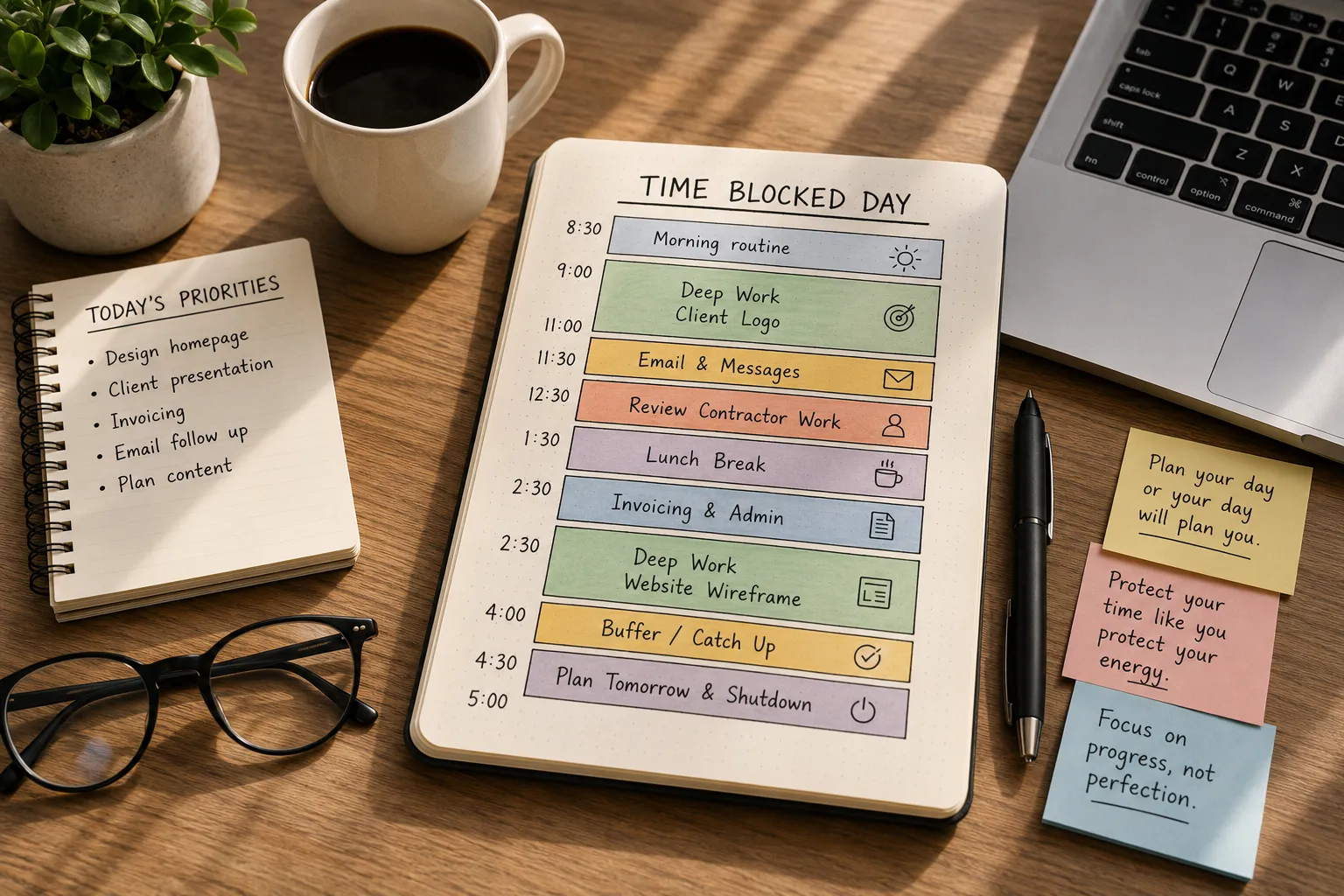
I open my calendar at 8:30 with coffee. 9 to 11 is deep work: client logo. Phone in the kitchen. 11 to 11:30 I batch email and Slack messages. 11:30 to 12:30 I review my contractor’s work for a website. Lunch, away from desk, no screen.
1:30 to 2:30 is invoicing and admin, the boring tasks I used to avoid until they became urgent and stressful. 2:30 to 4 is second deep work block: wireframes for a website. 4 to 4:30 is buffer. Anything that ran long goes there. If nothing ran long, I use it to plan tomorrow. At 4:30 I close the laptop.
The work is the same as before. The shape of the day is different. There’s no frantic mid-morning inbox check, no 3pm panic about an overdue invoice, no vague guilt at 9pm that I didn’t do enough.
Read More: The Feminine Glow Up That Has Nothing to Do With Makeup
The one habit that makes it stick
I review my blocks the night before, not the morning of. Five quiet minutes at 8:30pm. I look at tomorrow and ask: What are the two things that would make tomorrow feel successful even if everything else goes sideways? I block those first. That small evening review saves me an hour of indecision the next morning. I wake up already knowing where to start, which in winter in Canada when it’s dark until 7:45am is a gift.
If you want to try it, don’t block your whole week. Block two deep work windows this week, 90 minutes each. Notice how different the day feels when your attention has somewhere to land. That’s it. Over time the structure stops feeling restrictive and starts feeling like relief, because the decisions are already made and your only job is to begin.

Founder of MindSpaceGlow — I write about intentional living, mindset & productivity for a calmer life. Not a licensed therapist, but sharing practical, research-based tools that work in real life.
More about me →