Why Your Outfits Look Cheap Even When You Spend a Lot: 2026 Quiet Luxury vs. Micro-Trend Trap
Spending a lot but outfits still look cheap? It’s not price, it’s the micro-trend trap. Learn 2026 quiet luxury analysis and how to look expensive on any budget.
Trend Analysis: For the last two years, fashion has been split into two opposite directions. On one side, quiet luxury – The Classic Style: How to Look Elegant Without Trying – clothes that whisper, not scream. On the other side, micro-trends that last 6 weeks: bubble skirts, giant bows, tomato girl summer, mob wife aesthetic, butter yellow but only in one specific fabric.
The problem is algorithm made us buy both. We want to look timeless but we shop like trends change every Monday. Result: a closet full of pieces that each cost $40-$120, none that talk to each other, and outfits that look cheap even when you spent $600 that month.
I did this in 2024. I spent $520 in one month at Zara, Aritzia, and Sephora sale. Nothing looked expensive. I looked at my photos from that month – I looked busy, not put-together. My friend who spent $200 looked more expensive because her clothes matched.
It’s not price that makes you look cheap. It’s visual noise.
Problem: The 3 reasons your outfits look cheap (even when they’re not cheap)
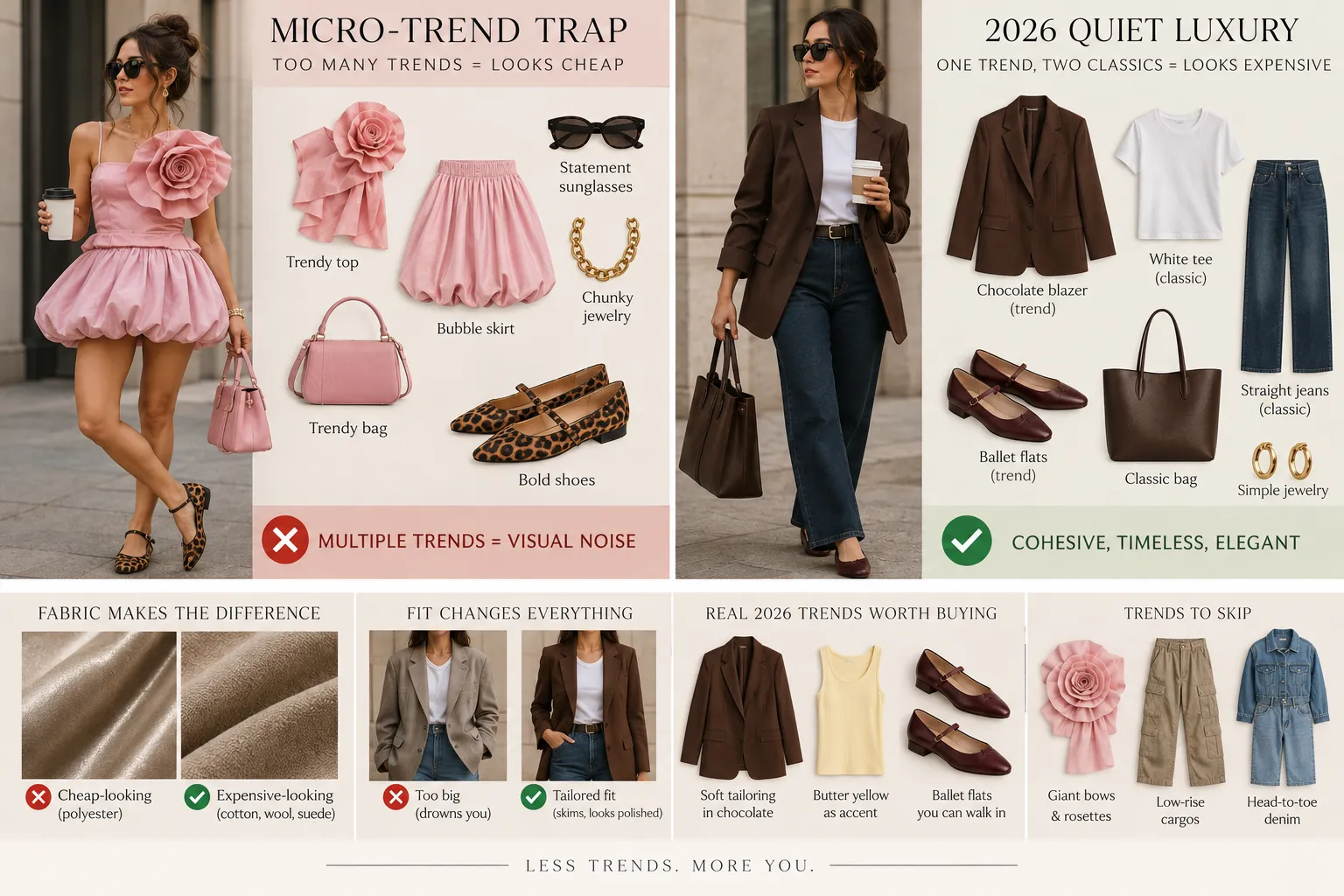
- You are mixing too many trends in one outfit. One trendy piece is stylish. Two trendy pieces is costume. Three is fast fashion ad. I see this everywhere in Toronto in 2026: leopard ballet flats + sheer skirt + giant rosette top + oversized blazer + chunky gold jewelry, all in one outfit. Each piece alone is trendy for 2026. Together, cheap.
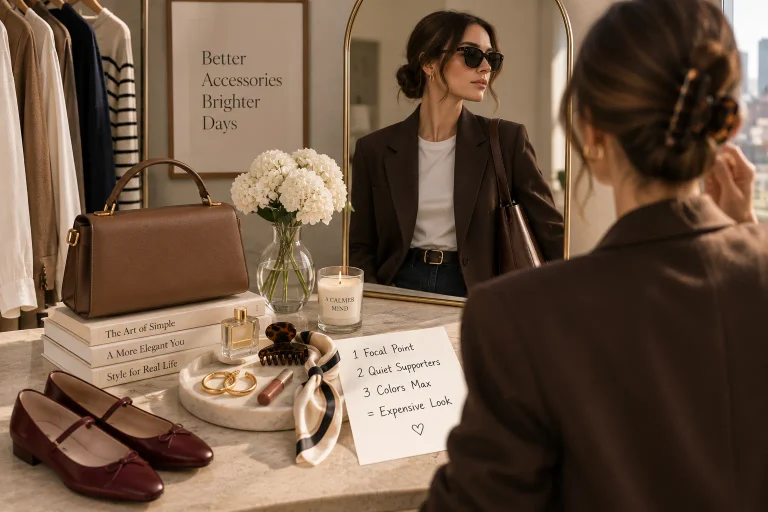
Your eye doesn’t know where to rest. Expensive outfits have one focal point, not five. Look at any woman who Always Looks Put-Together – she wears one interesting thing, rest is quiet.
- Your fabrics and fits are fighting. In 2026, micro-trends come in cheap fabric to keep price low and speed high. Polyester that shines under office light, ribbed knit that goes sheer when you stretch, seams that pucker after one wash. You can have $150 top that looks $20 because fabric is wrong.
Fit does same. Oversized cargos + oversized blazer + oversized tee = you look like clothes are wearing you. Expensive look is about fit that skims, not clings and not drowns. From The 3-Color Rule, we know color makes you look expensive. Fabric makes you look expensive even faster.
- You are copying the wrong person for your real life. I wrote about this in You Might Be Copying The Wrong People. If you are 5’4, size 8, walk 6,000 steps, work in office that is 19 degrees year-round, you cannot copy 5’11 model who is size XS, lives in LA, and gets driven everywhere. Her trend will look cheap on you not because you are cheap, but because it doesn’t fit your life.
Solution: The 2026 Quiet Luxury Filter (How I fixed it with $300)
I stopped shopping for two months. Then I did a closet audit using rules from Why You Have a Full Closet But Nothing to Wear. I pulled everything that looked cheap on me, even if expensive. 14 items left. All had same problems: too trendy, wrong fabric, wrong fit for my body.
Then I rebuilt using 2026 version of quiet luxury – not boring, not old money costume, but realistic quiet luxury for USA/Canada women who have jobs.
Rule 1: One trend, two classics. Formula I use now for every outfit, from 10 Outfit Formulas That Never Fail: 2 classic pieces + 1 trend piece. No more.
Example 2026: Classic: dark straight jeans + white tee that fits shoulders. Trend: chocolate brown soft blazer. That’s it. One trend, outfit looks current but not trendy.
Example 2: Classic: black straight dress + camel trench. Trend: burgundy ballet flats with small block heel. One trend, rest quiet.
If you wear leopard flats today, don’t wear sheer top and rosette. Wear white shirt and straight jeans. Let leopard be star.
Rule 2: Fabric first, label last. I touch before I buy now. I learned this from Summer Fashion Essentials: How to Build a Chic Capsule Wardrobe for Hot Weather. In 2026, best fabrics that look expensive without price:
- Cotton poplin for shirts, not polyester. Poplin holds shape, looks crisp, $35 from COS looks more expensive than $80 polyester blouse.
- Wool blend for blazers, not pure polyester. Even 20% wool makes drape better. My brown blazer is 45% wool, 55% poly, looks like $400.
- Suede or leather for shoes, not plastic. One pair real leather ballet flats, $165 Everlane, lasts 3 years, looks expensive year 2, while fake leather cracks month 4.
I check inside seam. If seam puckers on hanger, it will pucker worse on body. I put back.
Rule 3: Fit fix costs $15 and makes $40 look like $140. Most women buy size that fits biggest part of body, then whole outfit looks off. I buy to fit shoulders and hips, then tailor waist. In Toronto, hemming jeans is $15, taking in waist of blazer is $25. My $45 Zara sheer shirt looks expensive because sleeves hit right at wrist, not covering hands.
From The Classic Style: How to Look Elegant Without Trying, elegant is not effortless, it’s edited. Tailoring is edit.
2026 Trend Analysis: What to actually buy vs skip
Worth buying because they make you look more expensive and work with classic wardrobe:
- Chocolate brown soft tailoring, as I wrote last week. Trend but timeless.
- Butter yellow as accent, not head-to-toe. One butter yellow tank under navy blazer = expensive. Butter yellow dress + butter yellow shoes + butter yellow bag = cheap.
- Low block-heel ballet flats. Trend that solves real problem.
Skip because they make even expensive outfits look cheap by fall 2026:
- Giant logo belts. Quiet luxury is no logo.
- Head-to-toe denim same wash. Looks like costume, not outfit.
- Sheer everything without layering. One sheer piece layered = chic. Sheer top + sheer skirt = you look like you forgot lining.
Real math: How $300 looks more expensive than $600
Before: $600 month = 8 items fast fashion, $75 average, each worn once, none matching. Cost per wear $75, looks busy.
After: $300 = 1 chocolate blazer $178 + 1 burgundy flats $165, both match 12 items already in closet. 24 new outfits. Cost per wear after 3 months = $4.20. Looks calm, intentional, expensive.
That’s the difference between Your Glow Up Is Being SabotagedBy Good Habits – habit of buying more to feel better – and building identity: “I’m woman who owns less but wears it better.”
Your 20-minute fix tonight
Don’t shop. Audit. Pull 5 outfits you wore last week and felt cheap in. Lay on bed. Ask: How many trends in one outfit? Is fabric shiny in wrong way? Does fit skim or drown?
Remove one trendy piece from each outfit, replace with classic you already own – white tee, dark jeans, camel sweater. Take photo. You will see instantly which version looks more expensive.
I did this and returned $210 of stuff. My closet is smaller now. My photos look more expensive.
The prettiest thing about you was never what you bought, as I wrote in The Prettiest Thing About You Is Not What You Think. It’s ease with which you occupy room. Clothes that fit your life, your colors, your real day give you that ease. Clothes that fight your life make you look uncomfortable, which reads as cheap.
2026 trend is not more. It’s less, but better. Start with one trend, two classics. Your wallet and your mirror will thank you.

Founder of MindSpaceGlow — I write about intentional living, mindset & productivity for a calmer life. Not a licensed therapist, but sharing practical, research-based tools that work in real life.
More about me →