Your Future Is Built by the Decisions You Repeat Every Day
The Quiet Psychological Battle Between Temporary Comfort and Long-Term Growth
Meta Description
Why do people stay stuck even when they know what they should do? A deep psychological breakdown of discipline, dopamine, procrastination, focus, and the daily decisions that quietly shape your future.
Most People Don’t Ruin Their Future Overnight
That’s the uncomfortable truth.
A bad life is rarely created by one catastrophic decision.
It’s usually built through tiny daily compromises that feel harmless in the moment.
Five more minutes scrolling.
Putting something off until tomorrow.
Avoiding discomfort again.
Choosing distraction because focus feels mentally heavy.
Then one day, people look around and realize they somehow became disconnected from the person they once imagined becoming.
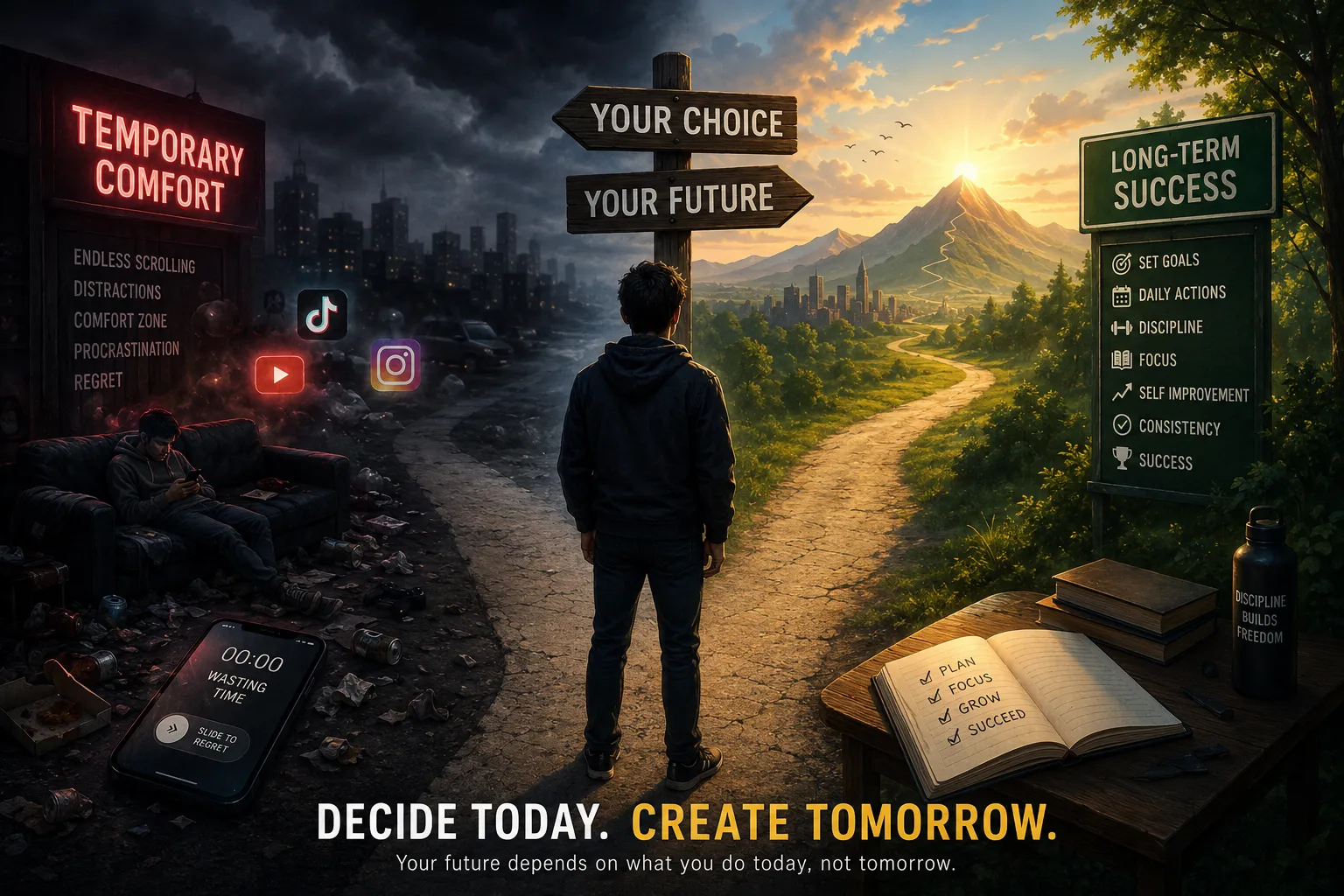
That’s what makes the message in this image powerful.
It’s not really about success versus failure.
It’s about the silent war happening every single day between:
- short-term comfort
and - the future version of yourself
And most people underestimate how much those small decisions matter psychologically.
Because every repeated action trains the brain.
Every habit rewires attention.
Every daily choice strengthens an identity.
Your Brain Was Never Designed for the Modern World
People blame themselves for lacking discipline.
But discipline is much harder now than it was even a decade ago.
Why?
Because modern digital environments constantly hijack the brain’s reward system.
Your mind naturally seeks:
- quick relief
- novelty
- stimulation
- instant rewards
- reduced effort
That’s why endless scrolling feels easier than deep work.
Why checking notifications feels more attractive than reading.
Why procrastination often feels emotionally safer than starting.
This is not simply laziness.
It’s dopamine conditioning.
Every short-form video, every notification, every rapid stimulation trains your nervous system to expect constant reward without effort.
Over time, normal life starts feeling “too slow.”
And that’s where the real damage begins.
Not because people stop caring about their goals.
But because their attention span becomes fragmented.
Procrastination Is Emotional, Not Logical
Most productivity advice completely misses this.
People think procrastination happens because someone is disorganized.
Usually, that’s not the real issue.
Procrastination is often emotional avoidance disguised as delay.
Underneath it, there’s often:
- fear of failure
- mental exhaustion
- overwhelm
- perfectionism
- internal resistance
- low self-trust
That’s why people sometimes grab their phone “for one minute” and disappear for an hour.
The brain is searching for emotional relief.
Temporary comfort reduces tension instantly.
But repeated avoidance slowly destroys self-respect.
And this matters more than people realize.
Because confidence is not built through motivation.
It’s built through evidence.
When you repeatedly abandon your own commitments, your brain notices.
Quietly.
Small Decisions Build Identity Before They Build Results
Most people obsess over outcomes:
- money
- fitness
- success
- achievements
But psychologically, identity comes first.
Every small action becomes a vote for the kind of person you believe you are.
When you keep promises to yourself — even tiny ones — your brain starts forming a new internal narrative:
“I’m someone who follows through.”
That shift is powerful.
Because sustainable discipline is not about forcing yourself constantly.
It’s about reducing the internal conflict between:
- who you are now
and - who you believe you can become
The strongest habits are identity-based.
Not motivation-based.
Digital Addiction Is Destroying Deep Focus
The most dangerous effect of constant stimulation isn’t wasted time.
It’s cognitive fragmentation.
After enough exposure to fast dopamine loops, the brain struggles with:
- sustained concentration
- patience
- deep thinking
- long-form learning
- mental stillness
Everything starts feeling mentally heavy.
Even important goals.
People then assume they’ve become lazy or unmotivated.
But often, their nervous system is simply overstimulated.
This explains why many people feel exhausted before they even begin working.
Not because they’re doing too much.
Because their attention is under attack all day long.
Success Is Usually Repetitive and Emotionally Unexciting
This is something social media rarely shows.
Real growth is often boring.
It looks like:
- consistent sleep
- focused work sessions
- repeated routines
- uncomfortable repetition
- showing up without excitement
Most people fail because they chase emotional intensity instead of behavioral consistency.
They wait to “feel ready.”
But high performers rely less on motivation and more on systems.
That changes everything.
Because systems reduce decision fatigue.
And fewer internal battles means more execution.
Environment Shapes Behavior More Than Willpower
One of the biggest myths in self-improvement is the obsession with willpower.
Environment matters far more than people think.
If distractions are always visible, attention will drift.
If your phone stays beside you constantly, you will check it.
If your space feels chaotic, focus becomes harder.
Productive people are not superhuman.
They simply build environments that make good decisions easier.
Sometimes the most life-changing improvements are surprisingly small:
- removing addictive apps
- creating phone-free hours
- cleaning your workspace
- designing a focused morning routine
- reducing mental clutter
Behavior becomes easier when friction is reduced.
The Real Goal Is Not Motivation — It’s Self-Trust
This is where true transformation begins.
Not with hype.
Not with dramatic inspiration.
But with rebuilding trust in yourself.
Every time you complete a small commitment, your brain collects proof:
“Maybe I can rely on myself after all.”
That internal shift changes behavior more than external motivation ever will.
Because once self-trust grows, discipline stops feeling like punishment.
It starts feeling like alignment.
How to Actually Change Without Burning Out
Most people try to change their entire life overnight.
That usually fails.
The brain resists sudden identity shifts.
A smarter approach is smaller and more psychological.
1. Reduce stimulation before increasing productivity
You do not need more motivation first.
You need less noise.
2. Make consistency easier than avoidance
Lower the barrier to starting.
Small wins matter.
3. Stop relying on emotion
Your future cannot depend on whether you “feel like it” today.
4. Build systems, not heroic moments
Lasting success is repetitive.
Not cinematic.
5. Protect your attention aggressively
Attention is no longer just focus.
It’s survival.
Your Future Is Hidden Inside Today’s Repeated Decisions
Most life changes are invisible while they’re happening.
That’s why people underestimate small habits.
But the direction of your life is shaped quietly:
- by what you repeat
- by what you tolerate
- by what distracts you
- by what you avoid
- by what you practice daily
The future rarely arrives suddenly.
It accumulates.
One decision at a time.
And eventually, those ordinary choices become your identity, your lifestyle, and your reality.
That’s the real message behind the image.
Not motivation.
Responsibility.
Because every day, whether consciously or not, you are choosing between:
- temporary comfort
or - long-term self-respect
And over time, that choice becomes your life.

Founder of MindSpaceGlow — I write about intentional living, mindset & productivity for a calmer life. Not a licensed therapist, but sharing practical, research-based tools that work in real life.
More about me →




One Comment