

5 Daily Habits That Keep You Stuck in Survival Mode
Stop living in survival mode. Discover the daily habits keeping you stuck and learn how to build routines that create progress, not chaos.
You’re not lazy. You’re not broken. You’re just stuck in survival mode, and you don’t even realize it.
Survival mode looks like this: You wake up already behind. You’re reacting to everything instead of leading your day. You’re constantly putting out fires. You collapse into bed exhausted but can’t point to anything meaningful you accomplished. Repeat tomorrow.
It feels like you’re busy. It feels like you’re trying. But you’re running in place, burning energy without making progress. And the worst part? The habits that keep you stuck are the same ones that feel normal, necessary, even productive.
Let me show you what I mean.
Why Routine Matters More Than Motivation
Here’s something most people get wrong: they think they need motivation to change their life. They wait for that spark, that moment of clarity, that burst of energy to finally get their act together.
But motivation is a terrible foundation. It’s unreliable, fleeting, and completely dependent on how you feel. Routine, on the other hand, doesn’t care how you feel. It just runs.
The Invisible Architecture of Your Life
- •Your routine—whether you consciously designed it or not—is the invisible architecture that shapes everything else. It determines:
- •What time you wake up and how you start your day
- •When you eat and what you choose
- •How you work and what you accomplish
- •When you rest and how you recover
- •What you think about and where your attention goes
Most people don’t have a routine. They have a collection of reactions and defaults that were never intentionally chosen. They’re living someone else’s design—their boss’s schedule, their phone’s notifications, their cravings’ demands.
From Chaos to Clarity
When you don’t have a solid routine, every single thing requires decision-making energy. Should I work out today? What should I eat? When should I start this project? Should I check my phone?
Each decision drains your willpower. By noon, you’re exhausted from deciding, and you haven’t even done anything difficult yet. So you default to whatever is easiest, which keeps you stuck.
A good routine removes decisions. It creates automatic behaviors that move you forward without requiring constant willpower. You don’t decide whether to work out—you just do it at 6:30 AM because that’s what happens every day.
The 5 Habits That Trap You in Survival Mode
Let’s get specific. These are the habits that create and reinforce survival mode:
Habit 1: The Chaotic Morning
You wake up without a plan. Maybe you hit snooze three times. Your phone is the first thing you touch. You check messages, scroll social media, read the news. Within minutes, your attention belongs to everyone except you.
You rush through getting ready. Skip breakfast or grab something quick and unhealthy. Leave the house already stressed. You’re reacting before the day even starts.
Why this keeps you stuck: Mornings set the tone. When you start reactively, you stay reactive all day. You’re always behind, always catching up, always responding to external demands. You never get ahead because you never take control.
What this costs you: Your best mental energy happens in the morning. By giving it away to your phone, other people’s agendas, and reactive tasks, you waste your most valuable hours. The deep work, creative thinking, and strategic planning never happen.
Habit 2: No Intentional Work Blocks
You sit down to work, but you don’t actually work. You check email. Respond to a message. Look something up. Get distracted by a notification. Start a task, get interrupted, start another task.
You’re busy all day but never in flow. You multitask constantly, which means you’re doing everything poorly. You confuse motion with progress.
Why this keeps you stuck: Fragmented attention produces fragmented results. You never go deep enough to solve real problems or create real value. You’re constantly context-switching, which drains energy and prevents mastery.
What this costs you: Without focused work blocks, you never build skills or produce meaningful output. You’re always working but never growing. Your value in the marketplace stays flat while everyone who knows how to focus pulls ahead.
Habit 3: Eating for Convenience, Not Performance
You don’t plan meals. You eat whatever is fast, easy, or sounds good in the moment. Breakfast is rushed or skipped. Lunch is takeout or whatever is in the office kitchen. Dinner is whatever you can grab on the way home or order online.
You’re either starving or stuffed. Your energy crashes mid-afternoon. You rely on coffee and sugar to stay alert. You tell yourself you’re too busy to meal prep.
Why this keeps you stuck: Your brain is an organ that runs on fuel. Bad fuel means bad performance. The blood sugar crashes, the inflammation, the brain fog—all of it makes it harder to think, decide, and execute.
When you feel like crap, everything is harder. Discipline is harder. Focus is harder. Resisting comfort is harder. You’re fighting with one hand tied behind your back.
What this costs you: Beyond the obvious health costs, poor nutrition destroys your daily performance. You could be 30% more focused, energetic, and capable. Instead, you’re operating in a fog, blaming laziness when the real problem is that you’re literally starving your brain.
Habit 4: No Clear Boundaries or Shutdown Ritual
Work bleeds into personal time. You check email at dinner. Think about work problems while trying to relax. Stay up too late because you never intentionally transitioned out of work mode.
You don’t have a shutdown ritual—a clear signal to your brain that work is done and recovery begins. So you’re always sort of working and sort of relaxing, which means you do neither well.
Why this keeps you stuck: Your brain needs clear transitions. Without them, you’re in a constant state of partial engagement. You can’t fully focus on work because you’re thinking about what you need to do later. You can’t fully rest because work thoughts keep intruding.
This creates chronic low-grade stress. You’re never really on or really off. You’re just always tired.
What this costs you: Recovery is when growth happens. Muscles rebuild during rest, not during the workout. Mental clarity returns during downtime, not during work. By never fully recovering, you’re preventing the growth you’re working so hard to achieve.
Habit 5: No Weekly Planning or Review
You don’t plan your week. You don’t review what worked and what didn’t. You just roll from Monday to Friday reacting to whatever comes up.
Each week is disconnected from the last. You make the same mistakes repeatedly because you never pause to learn from them. You work hard but can’t see if you’re actually progressing toward anything meaningful.
Why this keeps you stuck: Without planning and review, you’re navigating without a map or compass. You might be moving, but you have no idea if you’re heading toward your destination. You’re busy but not strategic.
What this costs you: Years pass and you wonder where they went. You worked hard the whole time but can’t point to significant progress. That’s because you were optimizing for busy, not for meaningful. Without planning and review, you never course-correct, so you stay stuck in patterns that don’t serve you.
How Reactive Mornings Damage Focus and Discipline
Let’s dig deeper into the morning habit because it’s the most critical.
The Morning Determines the Day
When you start your day reactively—checking your phone, responding to others, rushing through chaos—you set a pattern your brain follows all day.
Your brain learns: “We react. We respond. We’re behind. We’re in survival mode.”
Every reactive morning strengthens this pattern. Soon, reactivity isn’t something you do—it’s who you are.
The Dopamine Trap
When you check your phone first thing, you’re training your brain to crave immediate stimulation. You’re literally starting the day with a dopamine hit from notifications, messages, and scrolling.
This makes everything else feel boring by comparison. The deep work you need to do, the difficult conversations, the strategic thinking—all of it feels impossibly hard because your brain is already wired for constant stimulation.
The Willpower Drain
Every decision you make in a chaotic morning drains willpower. What to wear (because you didn’t plan). What to eat (because you didn’t prep). What to do first (because you don’t have a routine).
By the time you sit down to do real work, your willpower tank is half empty. The difficult, important tasks feel overwhelming. So you default to easy, unimportant tasks. Another day of survival mode.
What a Better Routine Actually Looks Like
Enough about what’s broken. Let’s talk about what works.
The Foundation: Morning Control
A good morning routine gives you control before the world demands your attention. Here’s a simple framework:
6:00 AM – Wake at the same time daily No snooze button. Your alarm goes off, you get up. Train your brain: we do what we say we’ll do.
- •6:00-6:30 – Win the morning**
- •Make your bed (first win of the day)
- •Hydrate (glass of water)
- •Move your body (10-30 minutes: walk, workout, stretch)
- •Phone stays away
- •6:30-7:00 – Prep for success**
- •Healthy breakfast
- •Review your plan for the day
- •Set your top 3 priorities
- •Still no phone
7:00 – Now you can check your phone You’ve already won the morning. Now you can respond to the world from a position of strength, not reactivity.
The Work Structure: Deep Work Blocks
Instead of constant task-switching, structure your work in focused blocks:
9:00-11:00 – Deep work block 1 Your hardest, most important task. No email. No messages. No interruptions. Just focus.
11:00-12:00 – Communication block Now you handle email, messages, meetings, admin tasks.
12:00-1:00 – Lunch and rest Actually take a break. Walk outside if possible. Let your brain recover.
1:00-3:00 – Deep work block 2 Second most important task or continuation of morning work.
3:00-5:00 – Collaboration and catch-up Meetings, team work, finishing smaller tasks.
The Evening: Shutdown and Recovery
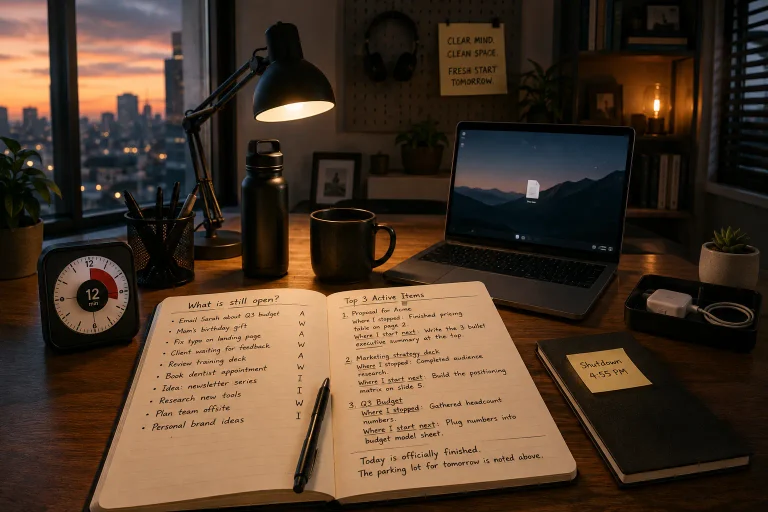
- •5:00-5:30 – Shutdown ritual**
- •Review what you accomplished
- •Plan tomorrow’s top 3 priorities
- •Close all work apps and tabs
- •Physical signal: change clothes, take a walk, whatever marks the transition
- •Evening – Recovery mode**
- •Meal with intention (no screens)
- •Movement or relaxation
- •Connection with people you care about
- •Wind down routine starting 90 minutes before bed
- •Phone charges outside your bedroom
Same bedtime every night Sleep is not negotiable. Protect it like you protect your most important meeting.
A Simple Reset Routine to Rebuild Momentum
If you’re reading this and feeling overwhelmed—like your routine is so chaotic you don’t even know where to start—here’s your reset plan:
Week 1: Morning Only
- •Don’t change everything. Just change your morning.
- •Set one consistent wake time
- •Do three things before touching your phone: 1. Make your bed 2. Drink water 3. Move for 10 minutes
That’s it. Just prove to yourself that you can control your morning.
Week 2: Add Evening Bookend
- •Keep your morning routine. Add an evening shutdown:
- •5:30 PM, review your day
- •Plan tomorrow’s top 3 priorities
- •Close work mode (change clothes, take a walk, whatever signals the shift)
Now you’re controlling both ends of your day.
Week 3: Add One Deep Work Block
- •Keep morning and evening. Add one focused work block:
- •9:00-11:00 AM
- •One task only
- •No email, no messages, no distractions
- •Phone in another room
You’re building the muscle of focus.
Week 4: Add Weekly Planning
- •Keep everything from weeks 1-3. Add Sunday evening planning:
- •Review last week: What worked? What didn’t?
- •Plan next week: What are your top 3 priorities?
- •Prep for success: Meal prep, lay out gym clothes, schedule deep work blocks
Now you have structure at the day, week, and year level.
Your Routine Is Building Your Life—Even If You Don’t Notice
Here’s the truth: you already have a routine. It’s just probably not serving you.
Every day, you follow patterns. You wake up a certain way. You start your day a certain way. You work a certain way. You end your day a certain way.
Those patterns are creating your results. If you don’t like your results, you need different patterns.
The good news? You don’t need to overhaul your entire life. You just need to fix the handful of keystone habits that create everything else.
Fix your morning, and your whole day improves. Add deep work blocks, and your value skyrockets. Create a shutdown ritual, and your recovery improves. Add weekly planning, and you start moving toward something instead of just surviving.
Conclusion
Survival mode feels normal because you’ve been in it so long. The chaos feels like that’s just how life is. The reactivity feels unavoidable. The exhaustion feels like the price of being busy.
But it’s not. You’re not supposed to feel this way. You’re supposed to have energy, clarity, and a sense of progress.
The difference between survival mode and growth mode isn’t talent, time, or resources. It’s routine.
Build a routine that serves your future instead of just managing your present, and everything changes. Not overnight. Not dramatically. But consistently, reliably, and permanently.
Your routine is building your life right now. The question is: what is it building?

Founder of MindSpaceGlow — I write about intentional living, mindset & productivity for a calmer life. Not a licensed therapist, but sharing practical, research-based tools that work in real life.
More about me →




One Comment