
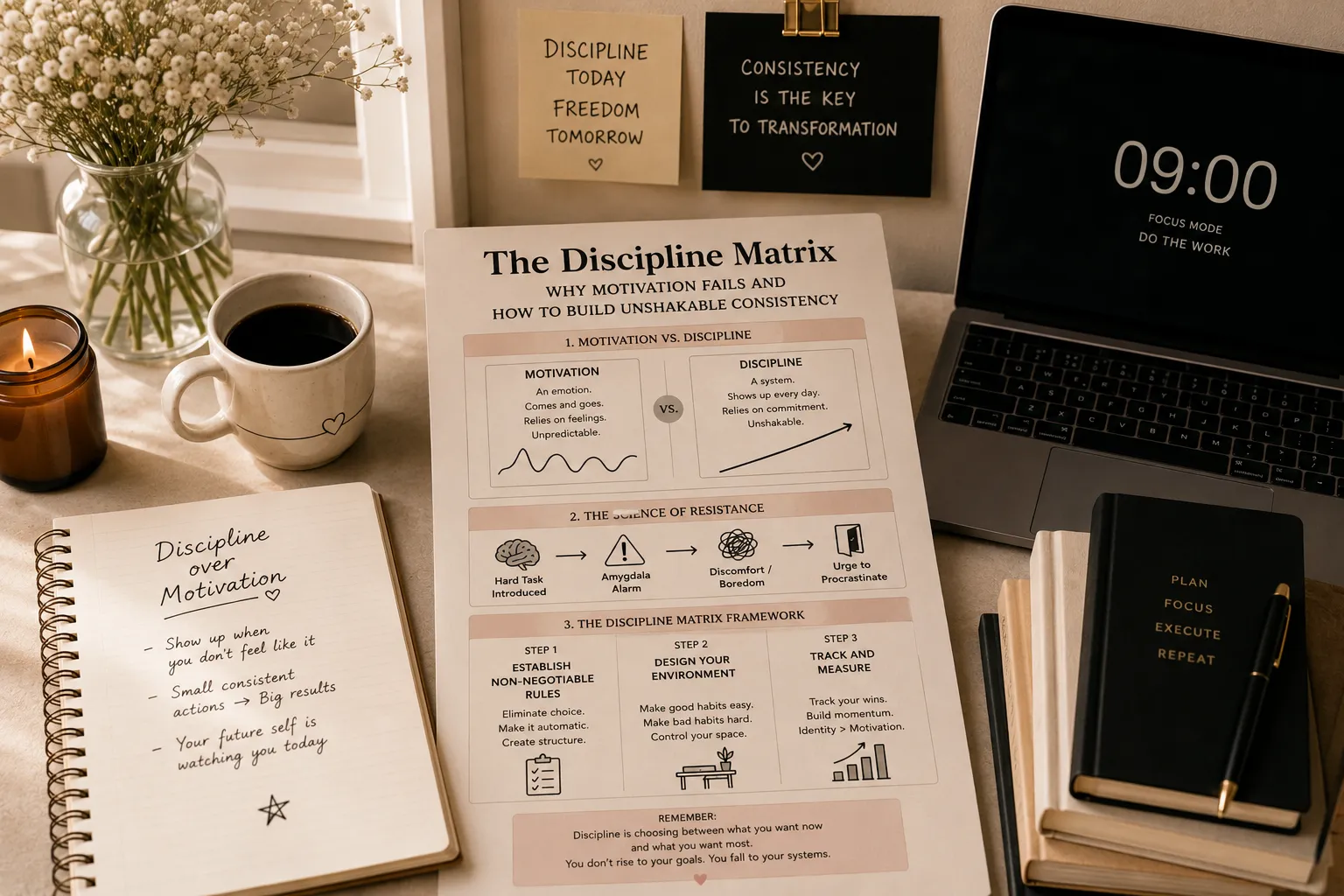
The Discipline Matrix: Why Motivation Fails and How to Build Unshakable Consistency
We have all experienced the sudden, intoxicating rush of late-night motivation. You watch an inspiring video, read a powerful quote, or suddenly realize that your potential is rotting in your comfort zone. In that fleeting moment, you feel completely invincible. You promise yourself that tomorrow will be the day you finally start your digital business, organize your entire life, fix your morning routine, and study for hours without a single glance at your phone.
But then, tomorrow arrives.
The alarm rings, the sky is grey, and the initial emotional high has completely evaporated. Suddenly, the tasks that felt effortless in your imagination now feel like climbing a mountain. Your brain immediately starts generating highly convincing excuses: “I didn’t sleep well,” “I’ll start fresh on Monday,” or “I just don’t have the motivation right now.” You choose comfort, hit the snooze button, slide back into procrastination, and allow your goals to sit on the shelf for another week.
If this cycle sounds familiar, it is because you are trapped in the motivation myth. The most significant mistake people make in their personal development journey is relying on an unpredictable emotion to complete hard tasks. To break this loop and achieve structural clarity in your life, you must transition away from emotional highs and install a reliable system of execution: The Discipline Matrix.
This high-value, comprehensive guide will explain the psychological failure of motivation, explore the neurobiology of resistance, and provide an actionable, step-by-step framework to build unshakeable consistency—even when you absolutely do not feel like it.
1. Motivation vs. Discipline: The Psychological Trap
To build a lifestyle of genuine freedom and accomplishment, we must clearly define the psychological difference between motivation and discipline. Treating them as the same thing is a recipe for chronic stagnation.
- Motivation is an Emotion: It is a chemical state driven by the anticipation of a fast reward or a temporary wave of inspiration. Because it is an emotion, it is highly unstable. It fluctuates based on your diet, your sleep cycles, your immediate environment, and even the weather. Relying on motivation to build your future is like building a house on shifting sand; it will collapse the moment the environment changes.
- Discipline is a System: It is the mental capacity to execute a critical task precisely when it needs to be completed, regardless of your current emotional state. Discipline doesn’t care if you are tired, bored, anxious, or uninspired. It bypasses how you feel and focuses entirely on what must be done.
The hard truth is that elite performers, successful entrepreneurs, and highly productive individuals do not possess a magical, never-ending supply of motivation. They feel the exact same resistance, fatigue, and desire to procrastinate as everyone else. The difference is they have built a system that makes execution non-negotiable. They understand that motivation does not precede action; action precedes motivation.
2. The Science of Resistance: Why Doing Hard Things Feels Painful
When you sit down to perform a demanding task—such as managing a complex digital workspace, writing an extensive article, or planning a business strategy—your brain experiences actual cognitive friction. This friction is not a sign that you are broken or naturally lazy; it is a fundamental survival mechanism.
Deep within the primitive architecture of the human brain lies the amygdala. The amygdala is responsible for processing fear, stress, and survival instincts. It operates on a very basic rule: maximize comfort, minimize energy expenditure, and avoid perceived threats.
To your survival-oriented amygdala, deep mental effort feels like a threat. It burns high amounts of glucose and requires intense focus. Therefore, when you attempt to move away from easy, high-dopamine activities (like phone scrolling) to enter a state of deep work, your amygdala triggers a subtle flight response. This manifests as a sudden wave of boredom, physical restlessness, and an intense urge to escape the task.
[ HARD TASK INTRODUCED ] ──> [ AMYGDALA ALARM ] ──> [ DISCOMFORT / BOREDOM ] ──> [ URGE TO PROCRASTINATE ]
When you understand this scientific reality, you realize that you do not need to wait for the discomfort to disappear before you start working. The discomfort is an automatic neural reflex. Building unshakable consistency simply means using your prefrontal cortex—the logical, rational part of your brain—to override the primitive amygdala and execute anyway.
3. The Discipline Matrix: A 3-Step Framework for Absolute Consistency
Transitioning from a reactive life of procrastination to an intentional life of discipline requires structural changes to how you manage your days. You must treat discipline as a skill that is trained through specific design choices.
Step 1: Establish Non-Negotiable Rules (Eliminate Choice Fatigue)
One of the primary killers of daily consistency is choice fatigue. Every single time you have to decide whether you are going to work, what you are going to do, or how long you are going to focus, you exhaust a fraction of your mental energy reserve. If you leave your productivity up to daily negotiations with your brain, your lazy side will win almost every single time.
To fix this, transform your critical tasks into Non-Negotiable Rules. Take the decision-making process completely out of your morning.
- Instead of saying, “I hope I can work on my project tomorrow,” establish a firm rule: “From 9:00 AM to 10:30 AM, my laptop is open to my primary workspace, my phone is completely powered down in another room, and I am typing. The outcome doesn’t matter, but the time block is sacred.”
When a behavior becomes a rule, you stop asking yourself how you feel. You simply execute because it is what you do.
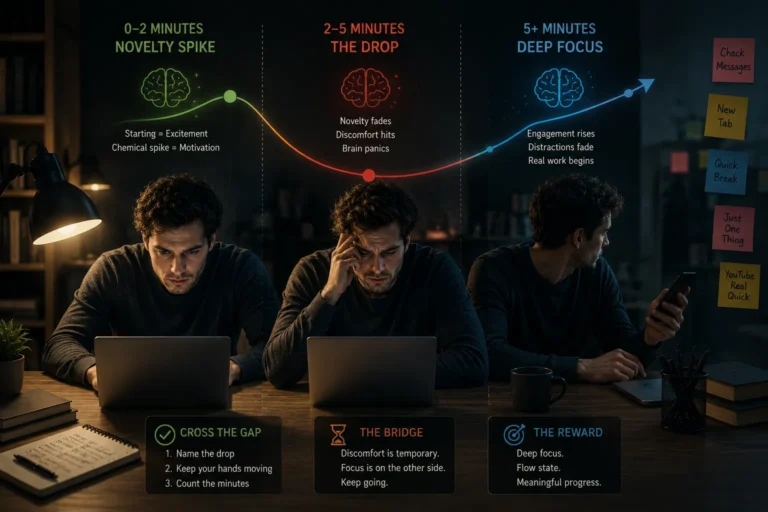
Step 2: Bridge the Focus Gap with Micro-Commitments
When you look at a massive, complex project, the sheer size of the task creates mental anxiety, which immediately triggers procrastination. Your brain views the entire project as a massive energy drain and convinces you to delay it.
To bypass this mental defense mechanism, leverage Micro-Commitments. Break the initial entry barrier down to an absurdly small, non-threatening step.
- If you need to plan a comprehensive strategy, make a commitment to simply open your template and write one bullet point.
- If you need to organize your finances, commit to opening the spreadsheet for exactly two minutes.
By shrinking the task down to a micro-step, you neutralize the amygdala’s fear response. Once you cross the initial threshold of friction and put yourself in motion, your momentum takes over, the cognitive resistance drops, and you will naturally want to continue.
Step 3: Design Radical Accountability Mechanisms
Human beings are naturally social creatures who respond heavily to consequences. If your goals are completely hidden inside your mind, breaking your promises carries zero immediate cost. You can procrastinate for days, and no one will ever know.
To build unshakeable consistency, you must create real consequences for your inaction:
- Visual Accountability: Keep a physical or digital habit matrix completely visible in your daily environment. Leaving your progress out in the open creates a psychological urge to keep the streak alive.
- Social Contracts: Tell a trusted peer, partner, or your digital audience exactly what you intend to accomplish by a specific date. The human desire to maintain a reputation of integrity acts as a powerful external force that pushes you through low-motivation days.
4. Identity Shift: Moving From “Trying” to “Becoming”
True, lifelong consistency cannot be sustained purely by white-knuckled willpower. For behavior change to be permanent, it must be deeply integrated into your personal identity.
Most people approach self-improvement from the outside in. They focus entirely on outcomes (e.g., “I want to earn a specific amount of money” or “I want to stop overthinking”). This is an unstable foundation. To make discipline effortless, you must shift your identity from the inside out.
| Outdated Framework (Outcome-Focused) | Elite Framework (Identity-Focused) |
| “I am trying to be organized and focused.” | “I am a disciplined, organized person.” |
| “I am trying to stop procrastinating.” | “I am someone who takes immediate action.” |
When you adopt an identity-focused mindset, your daily choices stop being a battle of willpower and start becoming an expression of who you are. A disciplined person doesn’t look at a beautifully formatted daily planning system and think, “I have to fill this out today.” Instead, they view using that system as a natural reflection of their lifestyle. You protect your time-blocks and track your execution because it matches your internal identity.
5. Systemizing Your Discipline: Offloading the Mental Weight
The human mind is an incredible tool for generating creative ideas, resolving complex issues, and thinking strategically. However, it is a terrible tool for storing a chaotic mess of daily tasks, unverified dates, and vague habits. When you force your brain to constantly remember everything you need to do, you overload your mental battery, causing high stress and inevitable burnout.
To maintain an unshakeable system of discipline without feeling mentally exhausted, you must offload your operational frameworks into a premium, external environment. This is why a clean, minimalist planning structure is a fundamental requirement for long-term consistency.
Using an interactive digital planner, an aesthetic daily layout, or a highly functional habit matrix template creates a visual brain dump. It translates your abstract goals into an organized, step-by-step roadmap for your day. When you open your planning template every morning, you aren’t guessing what matters; you are looking directly at a beautifully curated interface that guides your focus. It replaces your mental noise with structured peace, ensuring that your energy is spent entirely on executing your tasks rather than remembering them.
Conclusion: Hard Now, Easy Later. The Matrix is Yours.
Discipline is not a restrictive prison that destroys your creativity or robs you of your joy. In fact, the exact opposite is true. Discipline builds freedom.
When you allow yourself to be governed by temporary motivation, passing whims, and emotional resistance, you are a slave to your immediate impulses. You end up wasting hours in low-dopamine loops, building a future filled with distraction, regret, and unfulfilled potential. But when you choose the discipline matrix—when you set firm rules, ignore how you feel in the moment, and trust your productivity systems—you take complete ownership of your destiny.
Stop waiting for a wave of inspiration that may never come. Clear the digital clutter, establish your non-negotiable time-block, and cross the focus gap right now. Choose what is hard today so your life can be profoundly beautiful tomorrow.

Founder of MindSpaceGlow — I write about intentional living, mindset & productivity for a calmer life. Not a licensed therapist, but sharing practical, research-based tools that work in real life.
More about me →





One Comment