The Invisible Backpack: Why You Start The Day Already Exhausted, and the 12-Minute Shutdown That Fixes It
You know that feeling at 7:32 AM? You haven’t actually done anything yet. Your coffee is still too hot to drink. And yet your brain already feels full.
You’re thinking about the email you didn’t reply to. The Slack message you left on read to answer later. The half written doc sitting on your desktop titled final_final_v2. None of these things are hard on their own. But together they create this low grade hum that makes focusing on anything feel impossible.
Most productivity advice tries to fix this by adding more to your morning. Meditate. Journal. Cold plunge. Workout. I tried that for six months last winter in Toronto. I was up at 5:30 doing everything right, and by 9 AM I was mentally fried. The problem was not my morning routine. The problem was I never actually closed the previous day.
We treat our brains like a browser. We keep opening new tabs and then we wonder why everything is slow. Psychologists have a name for this, the Zeigarnik Effect. Your brain holds onto incomplete tasks almost twice as tightly as completed ones. That is exactly what creates those Unresolved Mental Loops: Why Your Brain Keeps Running Background Processes Even When You Try To Relax. It is not trying to torture you. It is trying to make sure you do not forget. But when you are juggling 15 to 30 incomplete things at any given time, that protective mechanism becomes a constant drain on your energy.
Think about your laptop. If you never quit apps, never close tabs, never shut it down, what happens? It gets hot, it gets slow, and the battery is dead by noon. That is exactly what we do to ourselves. We finish work by just stopping. We close the laptop lid at 5:47 PM in the middle of a sentence and we hope the next morning will feel like a clean slate. It never does. This is why you experience that strange sensation described in Why You Can’t Focus Even When Nothing Is Distracting You. The distraction is not in the room. It is carried over from yesterday.
I call it the Invisible Backpack. You take it off at night, but everything is still inside when you put it back on in the morning.
The fix is not a better morning routine. The fix is a closing routine. A deliberate shutdown protocol that tells your brain this is done for today, you can let go.
Here is the 12 minute version I have used for the last year with clients in the US and Canada, mostly remote workers and founders who thought they had a focus problem. They did not. They had a closing problem.
1. The Brain Dump With a Filter, 4 minutes
This is not a to do list. A to do list is a wish list. What you need is a capture list with a filter.
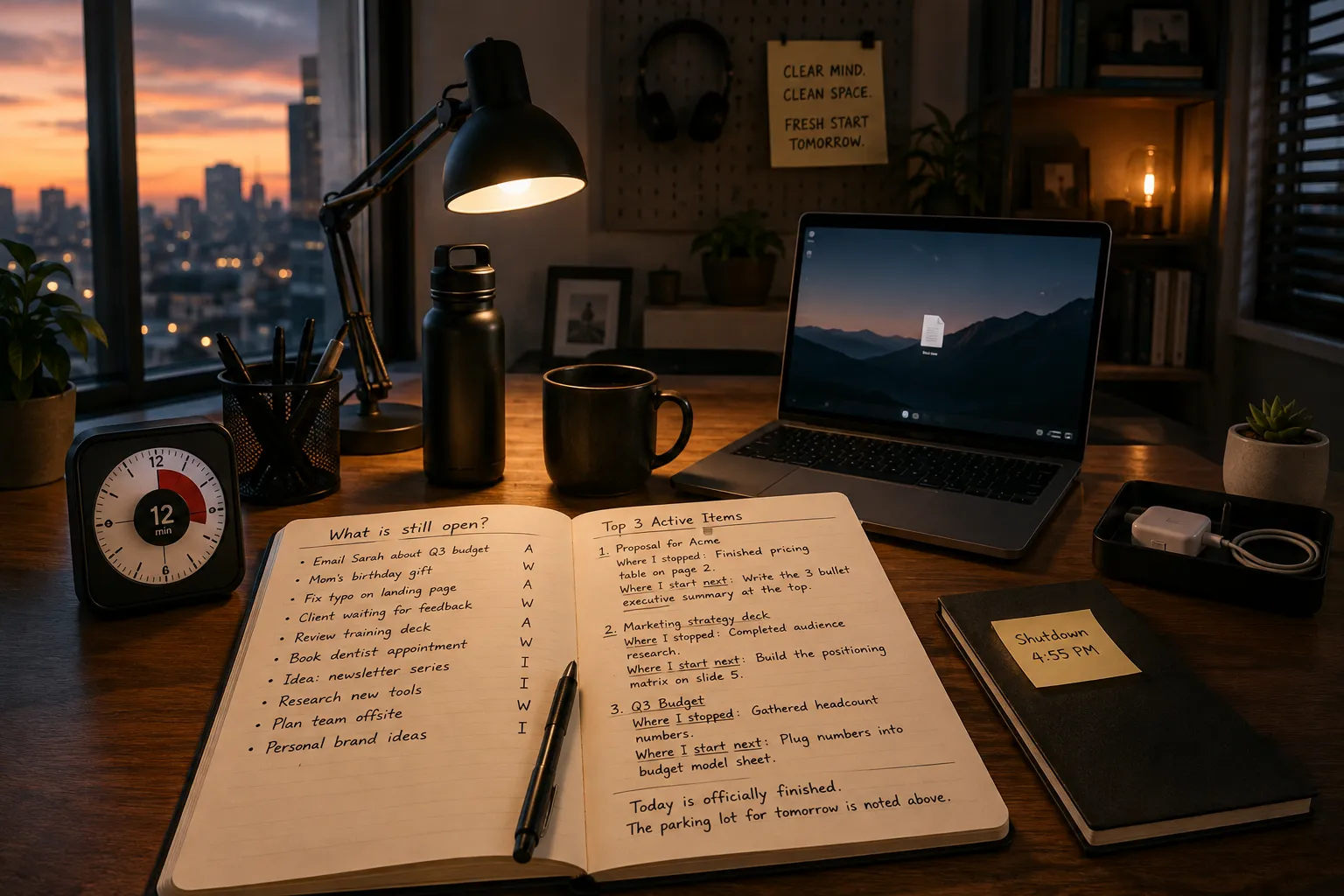
Take a sheet of paper, not Notion, not an app, paper works better for closure, and write at the top: What is still open?
Set a timer for 4 minutes and just dump everything out. Email Sarah about Q3 budget. Mom’s birthday gift. Fix typo on landing page. Do not organize. Do not prioritize. The goal is speed.
Now here is the filter most people skip. Next to each item, put one of three letters.
A for Active. This needs my attention tomorrow. It is a real task.
W for Waiting. I am waiting on someone else, or it is scheduled for later. It does not need my brain space tonight.
I for Idea or Noise. This popped up but it is not important this week. It is mental clutter.
This simple filter directly attacks Decision Fatigue: Why Simple Choices Drain Your Mental Energy. In my experience, about 40 percent of what feels urgent at 6 PM is actually W or I. When you see Waiting for client feedback written down in front of you, your brain finally gets permission to stop rehearsing it all evening. You stop wasting willpower on decisions that do not need to be made tonight.
2. The Two Sentence Close, 5 minutes
This is the core of the protocol. Pick your top 1 to 3 Active items, no more than that, and for each one write two sentences.
Sentence one: Where I stopped.
Sentence two: Where I start next.
Not what you should do. What you will do.
Instead of writing Work on proposal, which means nothing to your brain at 9 AM tomorrow, write this: I stopped after finishing the pricing table on page 2. I will start tomorrow by writing the 3 bullet executive summary at the top.
That specificity is everything. A vague task like work on proposal is an open loop your brain will keep spinning on all night. Write the 3 bullet summary is a closed loop with a clear entry point. You have given your future self a doorway, not a wall.
This is the antidote to Why Starting a Task Feels So Hard And How to Make It Easier and Why You Keep Procrastinating Even When You Really Want To Start. You are not procrastinating because you are lazy. You are procrastinating because your brain has no clear entry point, so it chooses Temporary Comfort vs Long-Term Growth.
If you have read about The Discipline Matrix: Why Motivation Fails and How to Build Unshakable Consistency, you know motivation does not create action, clarity does. This two sentence close gives you that clarity before motivation is even required.
I do this for the day itself too. One line at the bottom of the page: Today is officially finished. The parking lot for tomorrow is… It sounds a little silly, but that verbal cue matters. Without it, work just bleeds into Netflix and dinner and sleep.
3. The Friction Clean, 3 minutes
Look at your immediate workspace. Not a deep clean. Just 3 minutes of reducing starting friction for tomorrow morning.
Close all browser tabs except maybe one. Quit Slack and email completely. Put the one document you will open first tomorrow in the center of your desktop. Put your water bottle next to your laptop. Put your phone charger outside your bedroom if you can.
This is not about being tidy. It is about decision making. Researchers at Princeton Neuroscience Institute found that physical clutter competes for your attention and reduces performance. If you start your morning by spending 15 minutes figuring out what you were doing, where that file was, and why you have 34 tabs open, you have already spent your best focus.
This is a practical step toward Reclaiming Your Attention: How to Defeat Digital Distraction and Protect Your Focus and building a real Deep Work Protocol. The best morning routine is the one you do not need because you set it up the night before.
I started doing this at 4:55 PM every day. I set an actual calendar block called Shutdown. At first my team joked about it. Now three of them do it too. Not because it is trendy, but because it is the only thing that stopped that 9 AM exhaustion.
Most of us live in a state of permanent half finishing. We half finish emails, half finish thoughts, half finish conversations because a notification interrupts us. Each half finish is a small weight. No single one is heavy. But carry twenty of them for three weeks and you wonder why you feel burned out even though you did not do that much.
Try the shutdown for four days. Not a month, not a habit tracker challenge. Just four workdays. Time it. Twelve minutes.
Your future is not built by the big decisions you make once a year. As we explored in Your Future Is Built by the Decisions You Repeat Every Day, it is built by the small choices you repeat daily. And the most powerful small choice might be deciding when the day is truly done.

Founder of MindSpaceGlow — I write about intentional living, mindset & productivity for a calmer life. Not a licensed therapist, but sharing practical, research-based tools that work in real life.
More about me →