
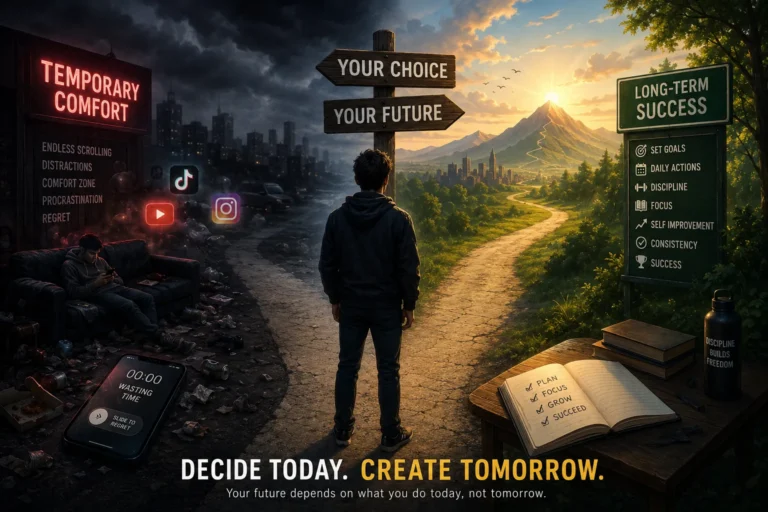
Temporary Comfort vs Long-Term Growth: the choices you’re making today
There’s a version of you ten years from now. Right now, that person is either thanking you or quietly resenting you.
I know that sounds dramatic. But think about it. The person you were in 2016 made decisions that led directly to where you’re sitting right now in 2026. The habits they kept, the shortcuts they took, the times they chose what felt good over what mattered. It all added up.
You’re doing the same thing right now for future you. And most of those choices don’t feel like choices. They feel like preferences, or just “who I am.” I’m just not a morning person. I’m just someone who needs to unwind with scrolling. I’m just not disciplined.
But what feels good today can cost you tomorrow, and the cost is invisible until it’s huge.
The lie of “just this once”
We are really good at convincing ourselves that individual choices don’t matter. One skipped workout doesn’t ruin your health. One SkipTheDishes order doesn’t destroy your budget. One night of scrolling until 1am doesn’t wreck your sleep.
You’re right. One doesn’t.
Read More: The 1% Daily Reset: How to Fix Mental Chaos and Digital Overload
It’s not about the one. It’s about the pattern you’re reinforcing.
Every time you make a choice, you’re casting a vote for the person you’re becoming. Choose comfort once, you’re taking a break. Choose it consistently for three months, you’ve become someone who chooses comfort. Your brain doesn’t distinguish between “just this once” and “this is who I am.” It just sees repetition and makes it automatic. After enough reps, you don’t even recognize it as a choice anymore. It’s just what you do.
Let me do math I wish someone taught me earlier. Thirty minutes a day of mindless scrolling is 182.5 hours per year. Over ten years, that’s 1,825 hours. That’s 76 full days. Two and a half months of your life, awake, spent on something that adds zero value.
Now imagine those same 30 minutes daily invested in learning a high-value skill, or building a small side business, or reading books that expand your thinking. Same time, same energy, completely different decade. That’s not motivational theory. That’s math. Small choices compound, both ways.
What comfort actually costs you
When you choose the comfortable option, you get instant relief. Tension disappears. Your nervous system calms. It feels like a reward.
Underneath, three things happen.
First, you’re training your brain to avoid discomfort. Each time you choose comfort when faced with a challenge, you strengthen the pathway that says discomfort equals danger, avoid it. Over time your tolerance shrinks. Things that used to be mildly uncomfortable now feel unbearable.
Second, you’re sacrificing future freedom. Skip the gym today, tomorrow’s workout is harder. Avoid the difficult conversation now, the problem grows. Buy on impulse this month, next month’s budget is tighter. Comfort now creates constraints later.
Third, and this is the one no one talks about, you lose respect for yourself. Every time you break a promise to yourself – “I’ll wake up at 6, I’ll go for a walk, I’ll save $50” – you teach yourself that your word means nothing. You become someone you can’t trust. That feeling sits quietly in the background and erodes confidence more than any external failure.
Someday is where growth goes to die
“I’ll start Monday.” “When things settle down.” “Next month when work is less crazy.”
Comfort loves the word someday. It lets you feel good about having intentions without the discomfort of action. But someday is a place that doesn’t exist. It’s a comfortable way to say never.
Meanwhile, time passes. In Toronto, I watched two friends start learning UX design at the same time in 2021. One chose comfort – watched tutorials passively, jumped between topics, never finished a project because it felt hard. The other chose growth – studied deeply for 30 minutes every morning, built one ugly portfolio piece, then another. Same talent level. By 2024, one had a new career making $85k, the other was still talking about starting.
Not because one made terrible choices. Because one kept making comfortable ones.
Read More: Reclaiming Your Attention: How to Defeat Digital Distraction and Protect Your Focus
Same hours, different future
Let’s compare, because the time is the same.
Comfort defaults: Hit snooze three times, check phone immediately, reactive morning. You start behind, responding to other people’s priorities. At work, do easy tasks first, avoid hard work, multitask constantly. You’re busy but not productive, skills stagnate. Evening: mindless scrolling, random Netflix, irregular sleep. No recovery. Weekend: abandon all structure to “reward” yourself. Lose momentum, make Monday harder.
Growth defaults: Wake intentionally, phone stays in kitchen, controlled morning. You start ahead, working from your own agenda. Tackle hard tasks first, 90-minute deep focus block, single-task. Meaningful progress, skills compound. Evening: wind down intentionally, prepare clothes for tomorrow, consistent sleep. Better sleep, actual recovery. Weekend: maintain core standards while resting strategically. Keep momentum, Monday flows.
Both take roughly the same hours. The difference isn’t time. It’s what you’re building with it. One feels easier now. The other creates an easier life later.
What growth actually requires, no sugar-coating
I wish growth was exciting. It’s not. It’s boring consistency.
First, discomfort tolerance. Not once in a while – regularly. You need to be able to sit with tension, uncertainty, boredom without immediately reaching for relief. I practice this by not picking up my phone when I feel a little anxious. Just sitting for 90 seconds. It’s uncomfortable. That’s the point.
Second, delayed gratification. You work today for benefits you won’t see for months. You save $100 now for a payoff that feels hypothetical. This is the hardest one for me. I want results now.
Read More: How Small Daily Choices Shape Your Future
Third, identity shift. You can’t grow into a new future while clinging to old labels. At some point you have to stop saying “I’m someone who struggles with discipline” and start saying “I’m someone who keeps commitments,” even before you fully believe it. You’re not faking. You’re becoming it one choice at a time.
Real timelines: First month, you’re just building the habit, it feels forced. First three months, small changes. First year, you start trusting the process. Years 2 to 5, real compound results. Years 5 to 10, different reality. Most people quit in month two because they don’t see dramatic results. They choose the comfort of familiar struggle over the discomfort of unfamiliar growth.
How to shift, practically
Don’t try to change everything. I tried. Failed in four days.
Step one, get honest on paper. I wrote: What comfort habits am I defending? Mine were phone first thing in morning, eating whatever was convenient, avoiding hard client feedback. Where will I be in five years if nothing changes? Same freelance income, same anxiety about money, same cluttered apartment. That truth stung enough to move me.
Step two, choose one future-building habit. One. Make it non-negotiable for 90 days. Mine was 30 minutes of focused learning daily, no phone, 9 to 9:30am. Not an hour, not two habits. One.
Step three, design your environment. Make comfort harder and growth easier. I deleted Instagram from my phone, not my account, just the app. Added friction. I put my gym bag by the door, reduced friction. I put my phone in the kitchen at night. Surround yourself with people who are growing. I started having coffee with one friend who reads a lot, instead of three who only complain.
Step four, track actions, not results. Did I do the habit today? Yes or no. How many days in a row? What percentage this week? Focus on consistency, not outcomes. Outcomes come, but only if you stay long enough.
Step five, speak differently. Not “I’m trying to be disciplined” but “I’m someone who keeps commitments.” Not “I want to be healthy” but “I’m someone who takes care of my body.” Language shapes identity.
Read More: 5 Daily Habits That Keep You Stuck in Survival Mode
The small choices quietly ruining your future
None of these will ruin your life today. That’s why they’re dangerous.
Checking your phone first thing every morning – choosing reactivity over intention. Eating whatever is convenient instead of what serves you. Avoiding difficult conversations for temporary peace. Consuming content instead of creating anything. Waiting for motivation before you act. Breaking small promises to yourself. Staying in your comfort zone because growth feels risky.
None ruin you today. They ruin you tomorrow.
Your future isn’t being determined by big decisions. It’s being created by daily defaults, moment-to-moment responses to discomfort.
Every time you trade long-term growth for present ease, you’re making a trade you can’t see until the bill arrives.
But every moment is also a chance to choose differently. Right now, you can decide your future self matters more than your present comfort.
Ten years from now, you’ll arrive somewhere. The only question is what you will have built in the meantime. And that answer depends on what you choose today, not someday.
Read More: The Discipline Matrix: Why Motivation Fails and How to Build Unshakable Consistency

Founder of MindSpaceGlow — I write about intentional living, mindset & productivity for a calmer life. Not a licensed therapist, but sharing practical, research-based tools that work in real life.
More about me →



One Comment