
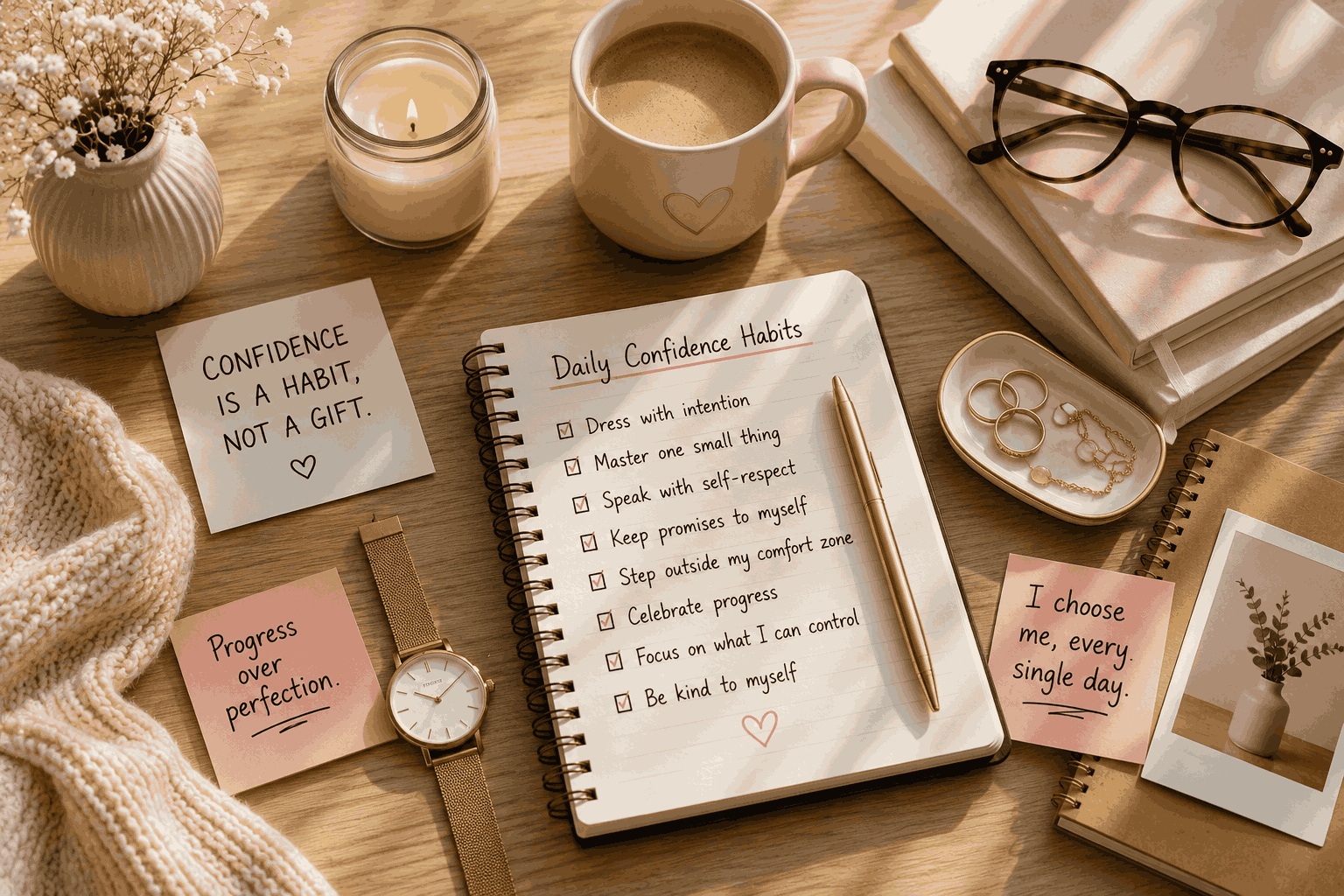
Self-Confidence: It’s Not a Gift, It’s a Habit You Can Build
There was a time when I thought confidence was something you were born with. Some people had it. The rest of us watched from the sidelines, admiring their ease, their posture, the way they walked into a room and owned it without saying a word.
I told myself I wasn’t one of the lucky ones. I was quiet, I overthought everything, I replayed conversations from three days ago. I was convinced confidence was a personality trait written in stone.
I was wrong. And if you’re reading this feeling the same way, you’re wrong too. But in the best possible way.
The people who radiate confidence weren’t born with a secret ingredient. They practiced. They failed. They adjusted. They kept going. Confidence isn’t a birthright or a genetic lottery win. It’s a habit you build slowly, sometimes messily, through small actions that compound.
This isn’t about toxic positivity or pretending you feel powerful when you don’t. It’s about the grounded, everyday work of building confidence that doesn’t crumble when someone criticizes your outfit or you make a mistake at work.
What confidence actually is, and what it isn’t
Confidence is not the absence of fear. Some of the most confident people I know still get nervous before a presentation. They still feel insecure sometimes. They still wonder if they said the wrong thing at dinner.
The difference is they don’t let that feeling stop them. They act despite the doubt. They speak up even when their voice shakes. They apply for the job even when they feel underqualified by two bullet points. They wear the red lipstick even when they worry it’s too much. Confidence is the decision to move forward with your values, even when your inner critic is telling you to shrink.
Read More: Habits That Create Discipline: The 5-Rule Framework (A Practical Guide)
And it’s not arrogance. Arrogance is loud, performative, and often rooted in insecurity. It needs to dominate the conversation. True confidence is quiet. It allows space for others. It admits mistakes. It says “I was wrong about that, thanks for telling me” and gets stronger, not weaker.
When I finally understood that, I stopped trying to feel invincible. I just tried to act.
Your brain can actually be rewired
Psychologist Carol Dweck talks about growth mindset – the belief that abilities can be developed through effort. When you believe you can improve, you’re more likely to take on challenges and persist.
Neuroscience backs it. Neuroplasticity means your brain reorganizes itself by forming new connections. Every time you practice a confident behavior, you’re literally rewiring. The first time I spoke up in a team meeting of 12 people, my voice cracked and my face went red. The fifth time, uncomfortable. The twentieth time? It started to feel normal. My comfort zone expanded. What once felt impossible became my new baseline.
That’s why confidence is a habit, not a trait. Habits are formed through repetition. They need consistency, not perfection. Anyone can build them, regardless of where they started.
Small daily habits that actually moved the needle for me
You don’t need a dramatic transformation. In fact, sustainable confidence comes from choices that seem too simple to matter. But they do.
Dress for the person you’re becoming, not the person you were when you were exhausted.
This isn’t vanity. It’s alignment. The way you present yourself sends signals to your own brain. When I wore clothes that fit well and felt comfortable and felt like me, my posture changed. I stopped apologizing for taking up space.
I don’t have an expensive wardrobe. I have intention. A crisp white shirt that fits my shoulders – mine is from Everlane, men’s size 6, $78. A pair of dark straight jeans that make me feel strong – Citizens of Humanity, bought in 2022 for $228, cost per wear now $1.52. A camel coat in a color that makes me smile on grey Toronto mornings. These are not superficial choices. They are acts of self-respect. They tell your brain, “I’m worth the effort.” When I stopped tugging at my waistband all day, I had more attention for the conversation in front of me.
Read More: Stop Procrastinating: A Simple System That Actually Sticks
Master one small thing every day.
Confidence grows when you prove you can do hard things. But hard is relative. For some, giving a presentation is hard. For others, making a phone call is hard. For someone else, getting out of bed and showing up is hard.
I started with my personal edge. Sending the email I’d been avoiding for three days. Taking a new route to work instead of the same one. Learning one new word in French – I live in Canada, I should know more than “bonjour.” Cooking a recipe I’d never tried, even if it was just a decent vinaigrette. Each small win is a deposit in your confidence bank. I keep a note on my phone called “proof” with dates. March 3: asked a question in meeting. March 11: told client I couldn’t take work this week. Over time those deposits add up to real wealth.
Practice the language of self-respect.
Listen to how you talk about yourself. I used to say “I just work in marketing” or “Sorry, but maybe this is stupid…” I dismissed everything before anyone else could.
Confident people speak differently. They say “I’m learning this” instead of “I can’t do this.” They say “I have a different perspective” instead of “Sorry.” They own their space without shrinking or dominating.
I started catching myself. Instead of “I don’t know if this is good enough,” I now say “I’ve done my best work and I’m ready to share it.” Instead of “I just do freelance design,” I say “I lead creative projects for small businesses.” The words you use shape the reality you live in. It felt awkward for two weeks. Then it felt true.
Move your body with intention, not punishment.
There is a connection between physical movement and mental confidence that is not just about endorphins. It’s about proving your body is capable.
You don’t need to run marathons. A twenty-minute walk in the morning can shift your entire day. I walk around Trinity Bellwoods without my phone. A short yoga video on YouTube, 12 minutes, can reconnect you with breath. Dancing alone in your room to your favorite song is not silly. It is a celebration that you are here, you are capable, and you deserve to feel good in your own skin. When I move with joy instead of guilt, I carry myself differently at 2pm.
Read More: Mental Fog: You Don’t Have a Focus Problem, You Have a Clarity Problem
Curate your environment ruthlessly.
The people you spend time with, the content you consume, the spaces you inhabit all shape confidence. If you’re surrounded by people who criticize, compare, compete, your confidence erodes. If your feed makes you feel inadequate, your confidence suffers.
I muted 47 accounts in one Sunday. No announcement. I follow people who inspire me without making me feel small. I spend time with friends who celebrate growth, even small growth. I clean my tiny apartment on Sundays for two hours because my external world mirrors my internal state. When my kitchen is clean, my brain feels cleaner.
You cannot build confidence without failing a little
Here is the truth no one likes but everyone needs: failure is not the opposite of confidence. It is the foundation of it.
Every time you fail and survive, you collect evidence that you are resilient. That rejection email? You survived it. That awkward conversation where you talked too fast? You survived it. That project that didn’t work? You survived and learned.
Most of us avoid failure at all costs. We stay in jobs we hate because we’re afraid of rejection. We don’t pursue creative work because we’re afraid of criticism. We shrink our dreams to fit our fears. But confidence is built by stepping into the arena, getting knocked down, getting back up.
Start small. Apply for something you’re not sure you’ll get. Share your writing even if you’re afraid of judgment. Say your truth in a conversation where you usually stay silent. Each time you survive discomfort, your muscle grows.
The mindset shift that changed everything for me
Stop asking, “Do I feel confident enough to do this?” Start asking, “Is this important enough to do even if I don’t feel confident?”
Confidence is not a prerequisite for action. It is a result of action. The most confident people didn’t wait until they felt ready. They acted first and confidence followed. They trusted they could figure it out along the way.
You are allowed to be a beginner. You are allowed to be imperfect. You are allowed to try before you feel prepared. In fact, that is the only way anything meaningful gets done.
If you take one thing from this, let it be this: you are not stuck with the confidence level you have now. It is not fixed. It is a habit.
Pick one habit from this article today. Dress with intention tomorrow. Speak with respect in your next meeting. Move your body for 10 minutes. Push one small edge. Survive one small failure.
You won’t wake up tomorrow as a different person. But you’ll wake up one step closer to the version

Founder of MindSpaceGlow — I write about intentional living, mindset & productivity for a calmer life. Not a licensed therapist, but sharing practical, research-based tools that work in real life.
More about me →