
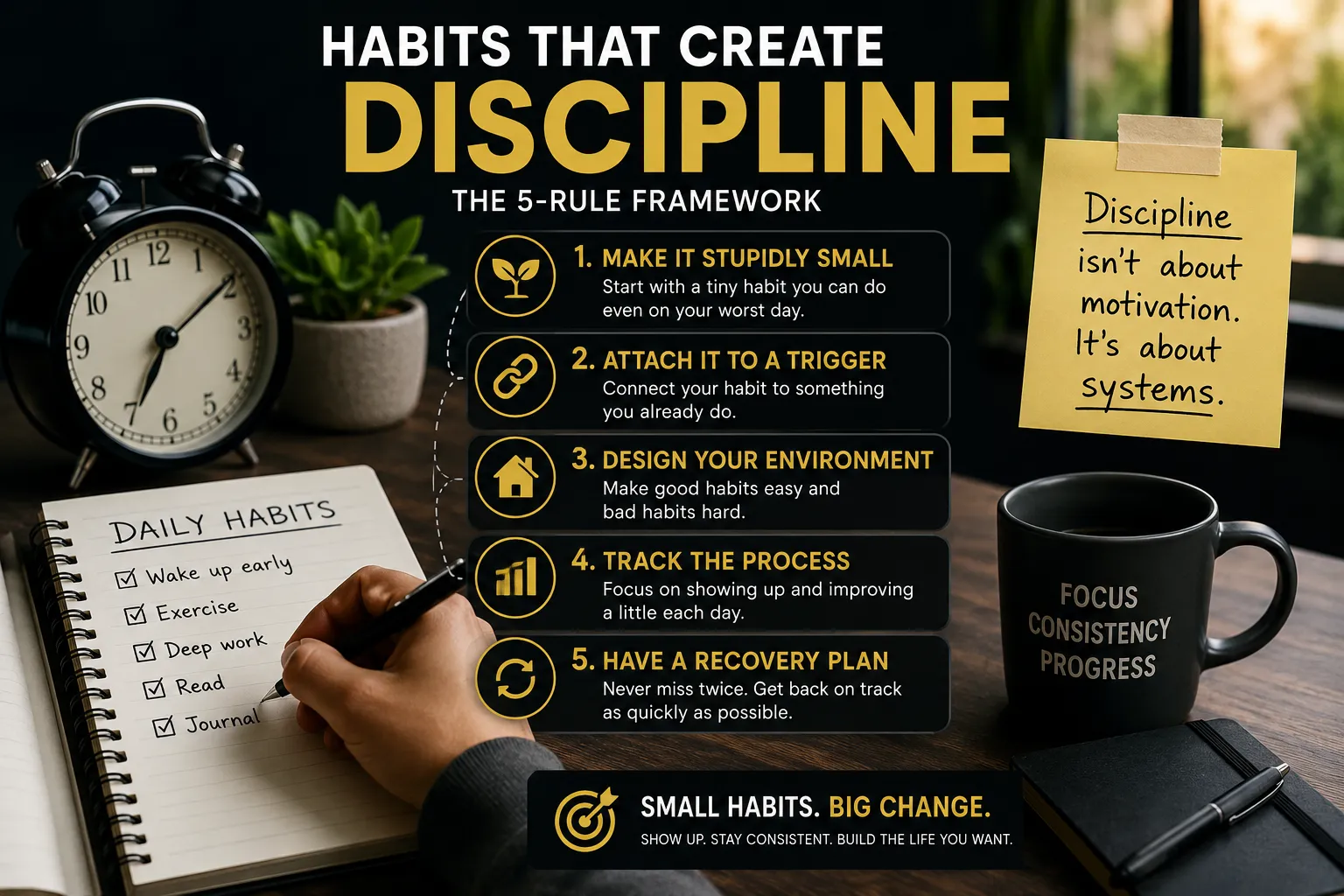
Habits That Create Discipline: The 5-Rule Framework (A Practical Guide)
Most people treat discipline like a personality trait. You either have it or you don’t. Some people are disciplined, the rest of us are just trying to keep up.
In reality, discipline is usually a habit problem. It’s the result of small behaviors repeated in predictable contexts, not a character trait you were born with.
If you rely on motivation, you’ll be consistent only on good days. If you build habits, consistency becomes your default even when you’re tired, busy, or not in the mood. I learned this in 2022 when I tried to be disciplined through willpower and failed by every Thursday.
This guide gives you a simple framework you can apply to anything: fitness, studying, deep work, saving money, getting your life back on track after a messy month.
Rule 1: Make it stupidly small (The minimum habit)
Discipline breaks when your habit is too big for real life. I tried to do one hour of exercise daily, an hour of reading, an hour of deep work. On paper, impressive. In real life with a job, laundry, and a small Toronto apartment, impossible.
The fix is a minimum version so easy you can do it on your worst day, when you’re sick, tired, or your period started.
Examples of minimum habits I actually use:
Exercise: put on gym clothes + 5-minute walk around block. That’s it. Often I do more, but minimum keeps streak alive.
Reading: 1 page. Not 30 minutes, 1 page. On bad days, I read 1 page and close book. Still counts.
Deep work: 10 minutes with phone in kitchen, away. Timer on.
Journaling: write 3 lines. Not a page, 3 lines.
Saving: move $5 to savings. Not $100, $5.
Minimum habits create identity shift: “I’m the kind of person who shows up.” Once you show up, you often do more, but minimum keeps streak alive even when life is messy. Bottom line: consistency beats intensity every time. I would rather see you do 5 minutes daily for 60 days than 2 hours once.
Rule 2: Attach it to a trigger you already do (habit stacking)
Habits stick best when they have clear starting signal. “I’ll do it later” never works because later has no trigger.
Instead use: After I [existing habit], I will [new habit].
Examples from my day:
After I brush my teeth, I will do 10 squats. Toothbrush is trigger, not time.
After I make coffee, I will write my top 3 priorities on sticky note. Coffee smell is trigger.
After I open my laptop, I will start 25-minute focus timer before checking email. Opening laptop is trigger.
After I put dinner dishes in sink, I will wipe counter for 2 minutes. Dishes are trigger.
This reduces decision fatigue and turns discipline into routine, not debate. Your brain stops asking “should I do it now?” because trigger decides.
Tip: use triggers that happen daily and around same time. Brushing teeth, making coffee, opening laptop, getting into bed. Don’t use triggers that are irregular like “after I go to gym” if you only go twice a week.
I have sticky note on my coffee machine: After coffee, 3 priorities. I see it every morning. Visible beats memorized.
Rule 3: Design your environment (discipline is often distance)
You don’t need more willpower, you need better design. Willpower is finite and tired by 3pm. Design stays.
Simple rule: make good habits easy and bad habits hard. Make right choice the easiest choice.
Environment upgrades that worked for me:
Put workout clothes where you can’t miss them – on chair next to bed, not buried in closet.
Keep water bottle on desk, filled. I drink more water when bottle is visible than when it’s in kitchen.
Block distracting sites during work hours. I use free extension BlockSite for Instagram and news from 9 to 11.
Charge phone outside bedroom. My phone charges in kitchen at 8:30pm. Morning problem is often bedtime problem, and bedtime problem is often phone-in-bed problem.
Keep book on pillow. Reading becomes default, not scrolling. I keep paperback on pillow, phone away.
Lay out gym bag night before. Decision made.
I stopped relying on motivation for healthy eating and started leaving washed berries at eye level in fridge. I eat berries because they’re first thing I see, not because I’m disciplined. Design.
Discipline improves when environment does half the work.
Read More; How Small Daily Choices Shape Your Future
Rule 4: Track the process, not just outcome
Outcomes like losing 10kg or earning $10,000 or getting promotion feel far away. You can’t control them daily. Process tracking creates daily wins you can control.
Use simple habit tracker. I use paper calendar on fridge, not app. Every day I mark:
Minimum habit done? Yes / No.
Bonus effort? Optional, e.g., did 20 minutes instead of 5.
Quick note: What helped? What got in way?
What to track: time spent (25 minutes focused work), reps completed (10 push-ups), days you showed up (streak). Not weight, not income, not likes.
Why this builds discipline: you stop asking “Do I feel like it?” and start asking “Did I follow process today?” That’s shift from feelings to commitment.
I track three habits only: walk, deep work block, 3 priorities. I don’t track 12 habits because tracking becomes chore and I quit. Three is sustainable.
Example week: Monday Yes + 30 min walk, helped: sunny. Tuesday Yes + 5 min only, got in way: late meeting. Wednesday No, overslept. Thursday Yes. That note about what got in way helps me design environment better next week.
Rule 5: Have a recovery plan (never miss twice)
Everyone misses days. Life happens, travel, sickness, deadlines in Canada winter when everything feels harder. Disciplined people aren’t perfect, they recover quickly.
Use Never Miss Twice rule: Miss one day = normal life. Miss two days = your habit is at risk, momentum breaking.
Create recovery plan before you need it, while things are calm. Future you at 7:52am when late will not invent one.
If I miss gym, I will do 10-minute home workout tomorrow morning, no equipment.
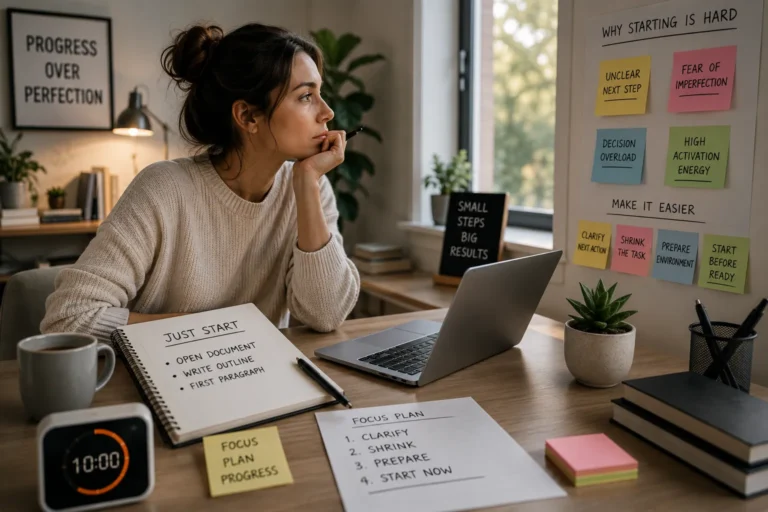
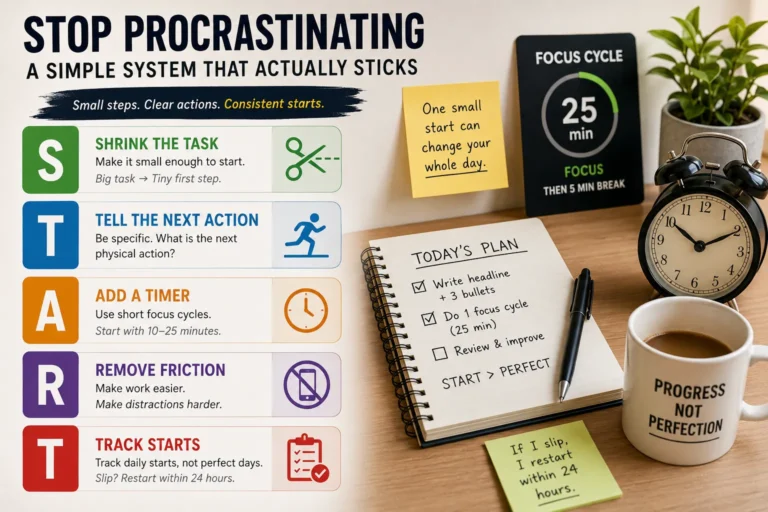
If I procrastinate, I will do 10-minute restart session and define next step, just one action.
If I oversleep, I will still complete minimum habit – 5-minute walk, 1 page reading – not full version.
Discipline is comeback skill, not perfect skill. I missed last Monday because I had migraine. Tuesday I did minimum 5-minute walk. Streak continued. Without recovery plan, one miss becomes week.
A simple weekly reset, 10 minutes
Once per week, Sunday or Monday, I do this with coffee. Set timer 10 minutes.
- Review tracker, 2 min. How many days did I show up? 4 of 7? That’s working routine.
- Pick one habit to prioritize this week, 1 min. Not three, one. This week my priority is deep work block.
- Re-define minimum habit, 1 min. Is 5-minute walk still realistic or should it be 10 squats because it’s -15 in Toronto?
- Confirm best trigger, 2 min. Is coffee still good trigger or should I use after brushing teeth?
- Remove one friction point, 2 min. One thing making it hard. This week I will move phone charger to living room.
- Plan one small reward, 2 min. Not food necessarily. My reward is Saturday morning at favorite coffee shop if I hit 5 of 7 days.
Keeps system realistic and sustainable.
Read More: Self-Confidence: It’s Not a Gift, It’s a Habit You Can Build
Common mistakes that kill discipline
Mistake 1: Doing too much too soon. I did this January 2023: new diet, new workout, new morning routine all on Jan 1. Failed Jan 4. Fix: minimum habit + gradual increases. Start with one habit for 7 days, then add.
Mistake 2: No clear trigger. “I’ll exercise after work” is vague, after work when? Fix: habit stacking with existing routine, after I change clothes after work, I will put on running shoes.
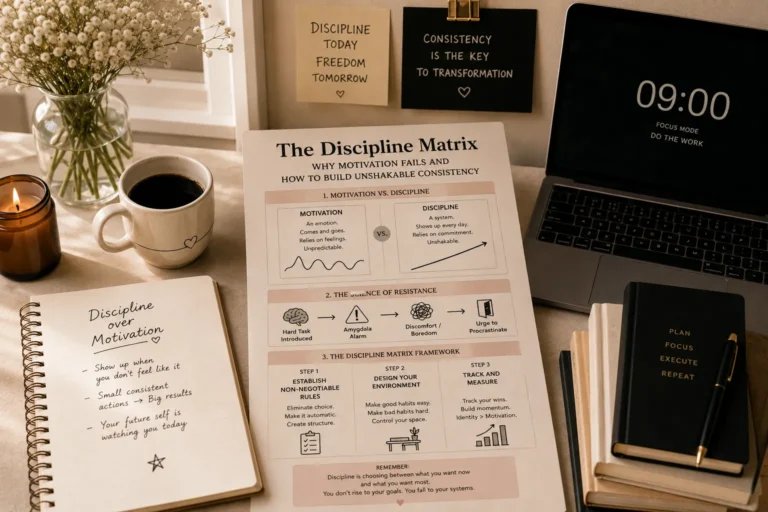
Mistake 3: Depending on motivation. Motivation is feeling, discipline is system. Fix: environment design + time blocks that don’t require motivation.
Mistake 4: All-or-nothing thinking. Missed one day so whole week ruined, so quit. Fix: never miss twice + recovery plan. One miss is data, not failure.
How long does it take?
Most people feel momentum within 1 to 2 weeks, but stable discipline comes from repeating simple routine over multiple weeks. Focus on showing up, not speed. I felt shift after 21 days of minimum walk, but real identity shift after 60 days. Now I feel weird if I don’t walk.
If overwhelmed and can’t stick to anything, start with one tiny habit for 7 days. Goal isn’t full transformation, goal is proof: I can keep promise to myself. Then add next habit.
Best habit to start with? Keystone habit that improves everything else: consistent sleep routine, 10 minutes movement daily, daily planning top 3 priorities, phone boundaries for focus. I started with sleep – phone in kitchen by 10:30pm – and everything else got easier.
You don’t find discipline, you build it with small repeatable actions. Use 5 rules: minimum habit, trigger, environment, track process, never miss twice. Start with one today.

Founder of MindSpaceGlow — I write about intentional living, mindset & productivity for a calmer life. Not a licensed therapist, but sharing practical, research-based tools that work in real life.
More about me →


2 Comments