
The Deep Work Protocol: How to Train Your Brain to Focus for Hours
In an era dominated by hyper-connectivity, instant notifications, and infinite scrolling, our collective attention span has faced a quiet crisis. If you have ever opened your laptop intending to execute a critical task, only to find yourself an hour later reading unrelated articles or looking at social media, you are not alone. Your attention has too many external owners, each bidding for a fraction of your cognitive energy.
The modern professional or student is not lacking in intelligence or desire; they are lacking in environmental control and attention training. True productivity is not about forcing yourself to do more shallow work under high stress. Instead, it is about cultivating the rare ability to concentrate deeply on demanding tasks without distraction. This mental state is what cognitive scientists and high-performers call “Deep Work.”
If you want to move past the constant cycle of mental chaos and build an elite level of concentration, you must understand that focus is not a fixed genetic trait. It is a muscle. This comprehensive guide will walk you through the precise, science-backed protocol to train your brain to focus for hours at a time, block out digital noise, and reclaim your cognitive potential.
1. The Neuroscience of Focus: Why Modern Brains are Fractured
Before you can fix your focus, you must understand why it feels so difficult to maintain in the first place. Your brain is a highly efficient, survival-oriented organ that evolved in an environment drastically different from the digital landscape of 2026.
Deep within our neurobiology lies the dopamine reward pathway. Dopamine is not the chemical of pleasure; it is the neurotransmitter of anticipation, novelty, and search. In the evolutionary past, a burst of dopamine encouraged humans to explore new territories, track moving targets, or find scarce food sources. Today, technology companies have engineered their applications to exploit this exact pathway.
Every notification ping, every algorithmically curated feed, and every red badge on your screen acts as an artificial novelty signal. When you check your phone, your brain receives a quick hit of dopamine. Over time, this constant exposure to high-stimulation environments rewires your neural pathways. Your mind becomes habituated to a state of chronic distraction, meaning that when you sit down to perform a task that requires sustained mental effort—such as writing, coding, or planning—your brain perceives it as boring and actively searches for a faster, easier dopamine loop.
Furthermore, every time you switch your attention from a primary task to check a text message or an email, you pay what psychologists call an “attention residue” tax. A portion of your cognitive processing power remains fixed on the previous disruption, even after you try to return to your work. This creates a state of fragmented focus, leaving you feeling mentally exhausted at the end of the day despite having accomplished very little actual work.
2. Defining Deep Work vs. Shallow Work
To build a reliable productivity system, we must establish clear boundaries between two completely different types of cognitive effort:
- Deep Work: Professional activities performed in a state of distraction-free concentration that push your cognitive capabilities to their absolute limit. These efforts create new value, improve your skill level, and are highly difficult to replicate.
- Shallow Work: Non-cognitively demanding, logistical-style tasks, often performed while distracted. These efforts—such as sorting low-priority emails, attending superficial meetings, or filling out repetitive paperwork—do not create much new value in the world and are incredibly easy to replicate.
Shallow work prevents you from failing, but Deep Work is what allows you to truly succeed. If you spend 80% of your working hours in a reactive state, answering other people’s requests and managing minor details, your potential is slowly rotting behind a facade of superficial busyness. To build a future shaped by design rather than default, you must deliberately allocate uninterrupted blocks of time to deep, creative, and strategic execution.
3. The 4-Step Deep Work Protocol to Reclaim Control
Transitioning from a state of chronic distraction to a state of high concentration requires a structured approach. You cannot simply rely on sheer willpower. Willpower is a finite energy reserve that depletes rapidly throughout the day. Instead, you must install a reliable protocol that automates your path into deep focus.
Step 1: Environmental Programming (The Clean Canvas)
Your immediate physical and digital surroundings are constantly programming your behavior. If your workspace is cluttered, noisy, and filled with tempting distractions, entering a state of flow becomes an uphill battle.
To program an optimal environment, adopt a minimalist approach:
- The No-Phone Rule: Your smartphone is the ultimate engine of distraction. Studies show that even having a phone resting face-down on your desk drains cognitive capacity because a portion of your brain must actively exert energy to resist checking it. During a deep work block, place your phone in another room or lock it inside a drawer on absolute silent mode. If your phone is out of sight, it is largely out of mind.
- Digital Decluttering: Close every browser tab that is not directly relevant to the immediate task. Turn off all desktop notifications, exit communication apps, and use full-screen modes for your work interfaces. Treat your screen as a premium canvas where only one focal point is allowed to exist.
- Sensory Anchors: Use specific environmental cues to signal to your brain that it is time to focus. This could be a clean desk surface, a specific lighting setup, or a dedicated instrumental playlist (such as lo-fi beats, ambient noise, or binaural beats). Repetitive exposure to these anchors builds a powerful Pavlovian association over time, making entry into focus smoother and faster.
Step 2: Time-Blocking and the 5-Minute Rule
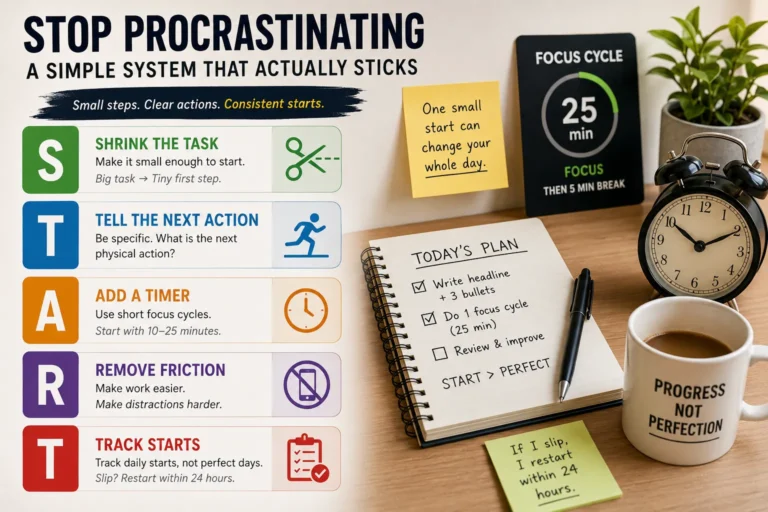
Vague plans lead to vague outcomes. If you sit at your desk with an undefined goal like “I need to work on my project today,” your mind will immediately drift toward easier, shallow alternatives. You must define exactly what you are going to do and when you are going to do it.
- Implement Tight Time-Blocks: Dedicate a specific, unmovable window on your calendar for deep work. For beginners, a 60-to-90-minute block is ideal. Treat this block with the same level of respect you would give to an important meeting with an external client.
- Leverage the 5-Minute Rule: The hardest part of any demanding task is almost always the friction of starting. When motivation is missing, give yourself a simple, low-pressure contract: “I am only going to sit down and work on this specific document for exactly five minutes. If I want to stop after five minutes, I am allowed to stop.” By lowering the barrier to entry, you bypass the brain’s defense mechanism against hard work. In 95% of cases, once you push through the initial five minutes of friction, your momentum takes over, the mental fog clears, and you choose to keep going.
Step 3: Attention Resistance Training (Embracing Boredom)
Most people fail to maintain deep focus because they have completely lost the ability to tolerate boredom. The moment they experience a brief pause in cognitive momentum, their hands instinctively reach for a device to fill the silence.
To build unshakeable concentration, you must practice resisting these micro-urges. When you are writing a difficult sentence or analyzing a complex data set and hit a mental wall, your brain will scream for an escape route (like checking tab configurations, opening a new app, or grabbing a snack).
Recognize this moment as the “Focus Gap.” Instead of giving in to the urge, sit with the discomfort for two minutes. Breathe through the resistance. By consciously choosing not to reward your brain with a distraction when it hits a wall, you weaken the underlying neural craving and build true cognitive stamina.
Step 4: The Strategic Mental Reset and Shutdown Ritual
A car cannot run at maximum speed indefinitely without blowing its engine, and your brain cannot maintain intense concentration without deliberate, high-quality recovery.
- Incorporate True Rest: Between your deep work blocks, step away from screens entirely. A break spent scrolling through a news feed is not a break; it is an additional wave of cognitive input that causes further mental fatigue. Instead, let your mind rest by taking a short walk, stretching, drinking water, or staring out a window. Allow your default mode network to activate, processing information in the background.
- Execute a Daily Shutdown Ritual: At the end of your working day, intentionally close out your open tasks. Write down a clear list of what needs to be handled tomorrow, organize your workspace, and mentally declare that work is complete. This explicit boundary prevents unfinished tasks from running in the background of your mind during your evening, ensuring that you fully disconnect, sleep deeply, and recharge your focus battery for the next day.
4. Moving From Motivation to Discipline: The Long-Game View
Many people wait for a sudden wave of inspiration or a burst of high motivation before they begin working on their core goals. This is a fragile strategy. Motivation is an emotion; it is highly unstable, influenced by your sleep quality, diet, weather, and mood.
Discipline, however, is a framework. It means doing what matters most, precisely when it needs to be done, regardless of how you feel in the moment. The hard truth is that motivation is largely useless without consistency. Relying on inspiration to build a career, a business, or a lifestyle of freedom is like relying on luck to win a race.
When you implement a structured protocol, you take the decision-making process out of the equation. You no longer ask yourself, “Do I feel like focusing right now?” Instead, you simply look at your schedule, clear your environment, apply the 5-minute rule, and execute. Hard choices now lead to an easier life later. Choosing comfort now almost always charges an expensive price down the road.
5. Elevating Your System: The Power of Premium Tools
While understanding the psychology of concentration is essential, executing this protocol consistently requires a practical system to map out your days, capture your ideas, and track your habits. Without a clear interface to organize your thoughts, your mind becomes overloaded with carrying too much mental weight.
To prevent cognitive overload, high-performers offload their mental frameworks into external systems. This is why investing in premium, thoughtfully designed organizational tools is a game-changer. Using an interactive digital planner or a minimalist, aesthetic workspace template allows you to visualize your daily time-blocks, define your top priorities, and visually monitor your personal growth journey.
When your planning system is clean, intuitive, and visually pleasing, it removes the friction of organization. It transforms tracking your habits from a tedious chore into an inspiring daily ritual. Find a system that matches your personal aesthetic, stick to it daily, and watch as your scattered thoughts transform into structural clarity.
Conclusion: Your Future is Built by Today’s Choices
Your attention is the most valuable asset you own. Every single day, a massive digital economy is actively working to buy, hijack, and monetize your focus. When you give away your attention to every passing notification and distracting urge, you are slowly giving away your future.
Real productivity isn’t about working yourself to exhaustion or managing a million minor tasks at once. It is about identifying what truly matters, creating a calm mind, and protecting your cognitive boundaries with absolute intensity. By implementing this deep work protocol—programming your workspace, treating focus as a daily training session, and relying on steady discipline rather than unpredictable motivation—you build a massive competitive advantage.
Stop waiting for the perfect moment or an effortless wave of inspiration. Clear your desk, put away your phone, and cross the focus gap today. Your future self is entirely built by the tiny, deliberate choices you make right now.

Founder of MindSpaceGlow — I write about intentional living, mindset & productivity for a calmer life. Not a licensed therapist, but sharing practical, research-based tools that work in real life.
More about me →




One Comment