WHY YOUR ROOM FEELS CLUTTERED (AND HOW TO FIX IT TONIGHT)
Spent hours organizing but your room still feels cluttered? The problem isn’t mess. It’s visual noise. Learn the hidden reason and 3 budget fixes you can do tonight.
You just spent two hours cleaning. Every surface is wiped down. Clothes are folded. Books are stacked. You even vacuumed under the bed.
But when you step back and look at the room, something still feels wrong.
It doesn’t feel calm. It doesn’t feel spacious. It certainly doesn’t look like those beautiful bedrooms you see on Pinterest.
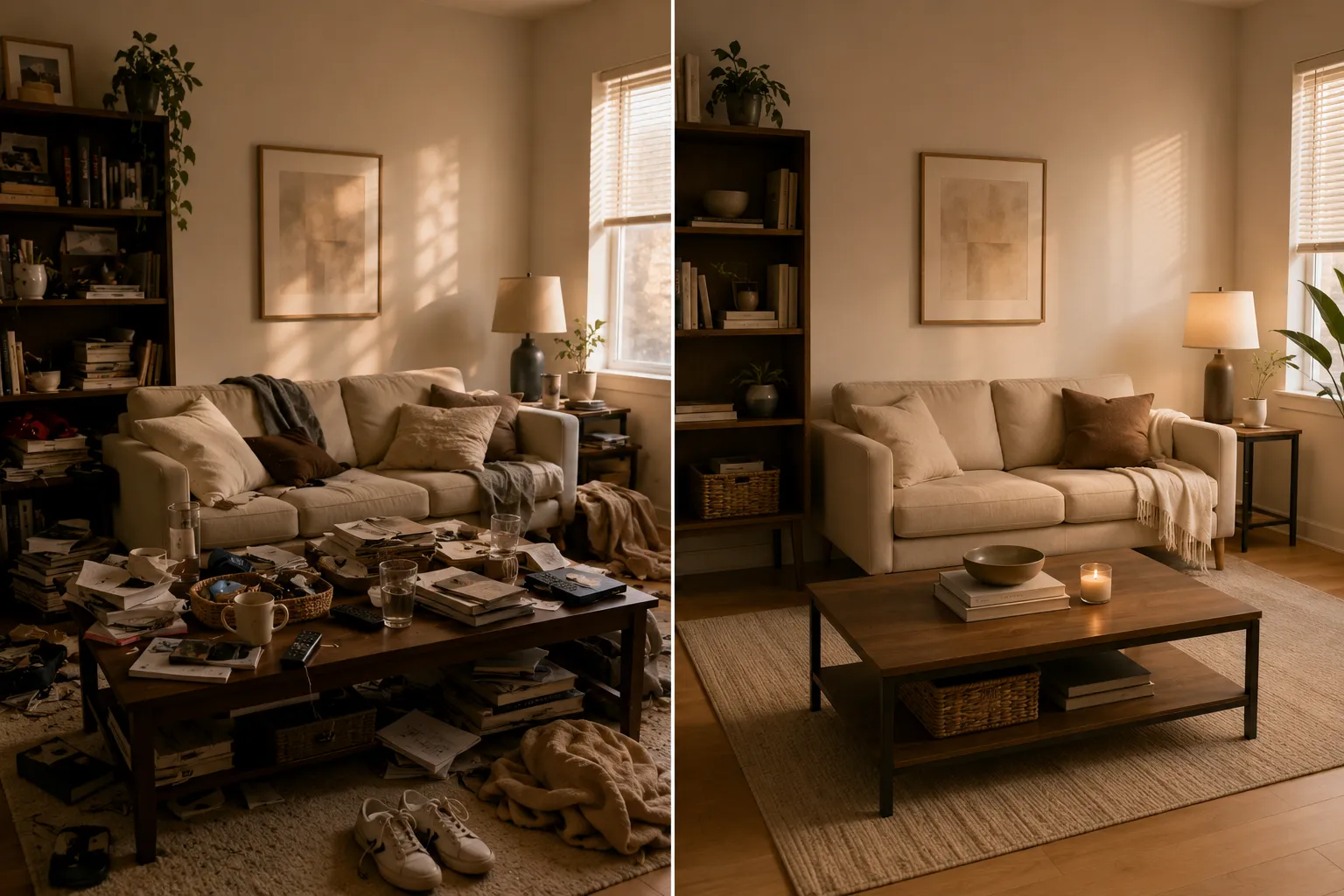
Your room feels cluttered, even though it’s technically clean.
Here’s the truth nobody talks about: The problem isn’t mess. It’s that your brain is still counting too many things.
Your Brain Counts Every Single Object
Walk into your bedroom right now and try this experiment. Count how many individual items your eyes can see without moving your head. Not categories. Individual objects.
That lamp. The charging cable next to it. Three books on the nightstand. A water bottle. A candle. A picture frame. The alarm clock. A jewelry dish. Two hair ties. A pen.
That’s eleven objects on one nightstand alone.
Now count the whole room.
Most people are shocked when they realize their “clean” bedroom contains 80 to 150 visible objects. And here’s the kicker: your brain processes every single one of them, even when you’re not consciously looking.
Each object creates a tiny mental task. “Is that important? Do I need to move it? Does it belong there?”
This is why your room feels cluttered. It’s not about dirt or disorder. It’s about visual noise.
The Three Invisible Clutter Traps (That Organizing Won’t Fix)
Most decluttering advice tells you to “put things away” or “get rid of what you don’t need.” That’s not wrong, but it misses the real problem.
You can have a perfectly organized room that still feels chaotic. Here’s why:
Trap 1: Open Storage That Exposes Everything
That cute wire basket holding your skincare? Your brain sees 12 bottles, not one basket.
The floating shelves displaying your book collection? Your eyes count 40 book spines in different colors and heights.
Open storage doesn’t reduce visual objects. It multiplies them. Every item inside becomes a separate thing your brain has to process.
Trap 2: Surfaces Covered in “Just One Thing”
You tell yourself: “It’s just my phone charger on the dresser.”
But next to it is “just” a hair brush. And “just” a receipt you need to deal with. And “just” yesterday’s coffee mug.
Five “just one thing” items create the same visual weight as a pile of laundry. But because they’re organized, you don’t see them as clutter. Your brain does.
Trap 3: Too Many Small Decor Items
Three small picture frames. Two candles. A decorative bowl. A plant. Another plant. A trinket dish.
Each one is pretty. Together, they create visual chaos.
The rule most people miss: One large item always feels calmer than five small items, even if the five items take up less physical space.
The One-Night Transformation (No Money Required)
You don’t need to buy new furniture or throw away half your belongings. You need to reduce what your eyes can see.
Here’s how to fix your cluttered room tonight, in less than 30 minutes:
Step 1: The 10-Item Nightstand Rule
Look at your nightstand (or the surface next to your bed). Count the visible items.
Your goal: Get it down to 10 items or fewer. Not by throwing things away, but by grouping or hiding them.
Put your charging cables inside the nightstand drawer. Stack your three books into one pile (your brain counts one pile, not three books). Put your jewelry into a closed box instead of a dish.
You’re not getting rid of anything. You’re just removing it from your brain’s constant counting system.
Step 2: Hide Half Your Open Storage
Get three boxes, baskets with lids, or even empty shoeboxes covered in wrapping paper.
Look at your open shelves. Take half the small items and put them inside closed containers.
Your brain will see three boxes instead of twenty-seven objects. The difference is immediate.
Step 3: The One-In-One-Out Surface Rule
Pick your three most-used surfaces: nightstand, dresser, desk.
New rule: Only one category of item per surface.
Nightstand gets only sleep-related items (lamp, book, water). Dresser gets only morning routine items (in one tray). Desk gets only work items (in one organizer).
Everything else goes inside a drawer or closed storage.
Why This Works (The Hidden Brain Science)
When you reduce visible objects, something shifts in your nervous system.
Researchers studying visual environments found that rooms with fewer than 40 visible objects create measurably lower stress responses than rooms with 80+ objects. Your heart rate actually drops. Your shoulders relax.
It’s not about minimalism or throwing away things you love. It’s about giving your brain fewer things to track.
Think of it like tabs on a computer. You can have 50 tabs open and the computer still works, but it runs slower. Your brain does the same thing.
Close the visual tabs. Keep what you need, just hide it from view.
The Real Reason Your Room Still Doesn’t Feel Cozy
You’ve reduced the clutter. You can finally see your surfaces. The room feels cleaner, calmer, more spacious.
But when you walk in at night, something still feels off.
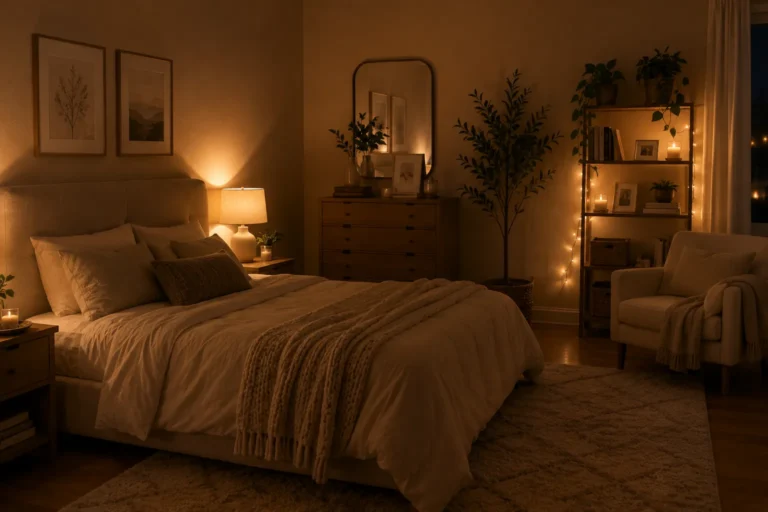
The room looks better, but it doesn’t feel warm. It doesn’t wrap around you the way those beautiful bedrooms in the photos do.
You fixed the visual noise, but now the room feels a little cold. A little empty, even.
That’s because there’s a second invisible problem lurking in your space. And it has nothing to do with what you can see.
It’s about what happens when the sun goes down.

Founder of MindSpaceGlow — I write about intentional living, mindset & productivity for a calmer life. Not a licensed therapist, but sharing practical, research-based tools that work in real life.
More about me →