Why You Lose Focus Two Minutes After You Start
You finally start working and within minutes your focus shatters. Discover the invisible chemical drop that pulls you out and how to stay in the zone.
Something strange happens when you finally sit down to work. For the first minute or two, you feel it. Clarity. Intention. Your mind locks onto the task. You are actually doing it. And then, without warning, the feeling vanishes. Your attention fractures. You reach for your phone. You open a new tab. You feel an itch to check something, anything, other than what is right in front of you. Within two minutes, the door that opened slams shut.
We left off asking why your brain lets you in, only to push you back out. What happens in those first minutes of focus that your brain finds so threatening? The answer lies in a chemical shift so fast and so invisible that you never see it coming. But once you understand it, every broken focus session you have ever had suddenly makes perfect sense.
The Novelty Spike
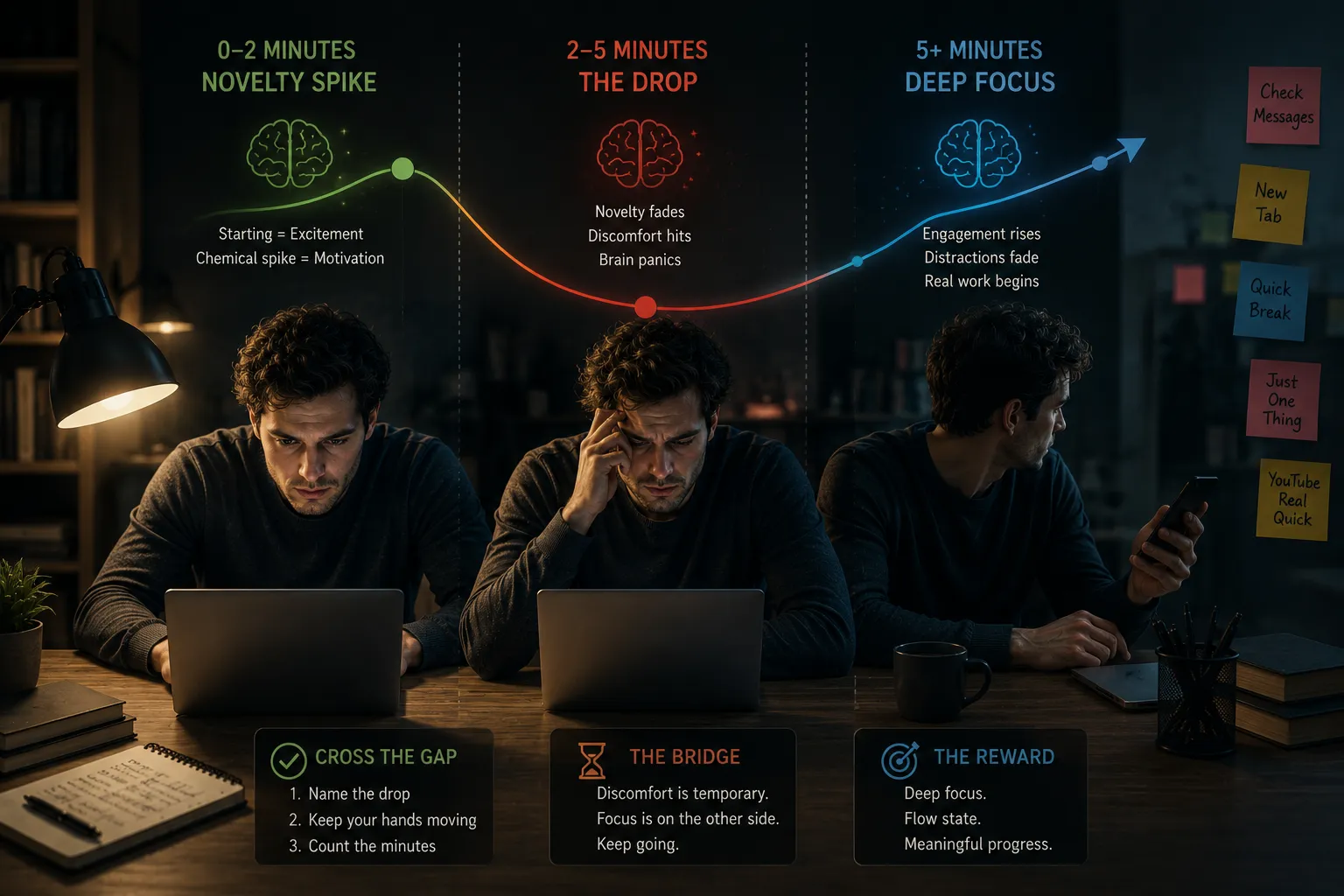
Your brain has a reward chemical that surges whenever you encounter something new. It is the same chemical that makes you click on a new video, open a new message, or start a new project. This chemical does not care about importance. It only cares about novelty. Starting something new triggers a spike. That spike feels like energy. Like motivation. Like focus. But it is none of those things. It is a temporary high.
When you sit down to work, you get a small hit of this novelty spike simply because you are beginning. The first sentence of an essay. The first line of code. The first paragraph of a report. Your brain lights up because starting is exciting. For about ninety seconds to two minutes, you ride that spike. You feel locked in. But here is what nobody tells you: the spike is not focus. It is chemistry. And chemistry always fades.
The Two-Minute Drop
After roughly two minutes, the novelty chemical drops. Not gradually. Not slowly. It falls off a cliff. One moment you feel engaged, and the next moment the task feels flat. Boring. Uncomfortable. Your brain, which was getting rewarded for paying attention, suddenly stops getting that reward. And when the reward stops, your brain panics.
This panic is subtle. You do not feel afraid. You feel restless. Anxious. Bored. Unsettled. Your brain starts scanning for the next novelty hit, the next interesting thing, the next stimulation. That is why you suddenly remember you need to check something. That is why you open a new tab without thinking. That is why your hand reaches for your phone before you even decide to pick it up. You are not being lazy. Your brain is chasing the chemical it just lost.
Think of it like a sugar rush. When you eat something sweet, you feel a burst of energy. But when the sugar wears off, you crash. You feel tired, irritable, and hungry for more sugar. Your brain does the same thing with novelty. It spikes, then crashes, and in the crash, it desperately looks for the next spike. This is the Two-Minute Drop, and it is the single biggest reason you cannot sustain focus.
Why The Drop Feels Like A Wall
The Two-Minute Drop does not just remove stimulation. It creates discomfort. When the novelty chemical drops, your brain enters a gap between the high of starting and the steady rhythm of deep focus. That gap feels awful. It feels like pushing through mud. Like forcing yourself to keep going when every cell in your body wants to stop.
Most people never make it through this gap. They hit the discomfort and immediately seek relief. They check their phone. They grab a snack. They switch to an easier task. And each time they do, they reset the cycle. They get another tiny novelty spike from the new activity, which feels good for another two minutes, and then they crash again. This is why your day can feel busy but produce nothing meaningful. You are spending the entire day riding and crashing instead of crossing the gap.
The Focus Bridge
The gap between the novelty spike and real focus is not a wall. It is a bridge. And like any bridge, you just need to cross it. On the other side of the discomfort lies something your brain does not expect: a second, much more stable kind of focus. This second kind is not powered by novelty. It is powered by engagement. Once you push through the Two-Minute Drop, your brain switches from chasing new stimulation to sinking into the task itself. The work becomes interesting not because it is new, but because you are in it.
The problem is that most people never experience this second kind of focus because they always bail out during the gap. They assume the discomfort means the task is wrong, or they are wrong, or they just cannot focus today. But the discomfort is not a signal to stop. It is a signal that you are about to cross over.
How To Cross The Gap
You cannot eliminate the Two-Minute Drop. It is hardwired into your brain. But you can train yourself to move through it instead of running from it. Here are three techniques that make the crossing easier.
1. Name The Drop
The moment the discomfort hits, say to yourself: “This is the drop.” Not “I cannot focus.” Not “This is boring.” Not “Something is wrong with me.” Just: “This is the drop.” Naming it does something powerful. It separates you from the feeling. Instead of being inside the discomfort, you are observing it. And observed discomfort is much easier to sit with than unnamed panic. The drop lasts roughly three to five minutes. Once you know what it is and how long it lasts, it loses its power over you.
2. Keep Your Hands Moving
During the drop, your brain will beg you to switch tasks. The easiest way to refuse is to keep your hands physically engaged with the work. If you are writing, keep typing even if the words are garbage. If you are reading, keep your finger under each line. If you are designing, keep moving elements around. Physical motion prevents the mental escape. Your brain cannot fully abandon a task while your body is still interacting with it. The hands anchor the mind.
3. Count The Minutes
Set a silent timer for five minutes after you start. Tell yourself: “If I still feel this uncomfortable after five minutes, I can stop.” Most of the time, you will not need to stop. The gap passes somewhere between minute three and minute five, and on the other side, focus comes naturally. But having the permission to quit makes the discomfort bearable. It is the same reason the five-minute trick works for procrastination. Your brain will endure almost anything if it knows there is an exit.
What Waits On The Other Side
When you cross the Two-Minute Drop, something remarkable happens. Your brain stops scanning for novelty and starts processing depth. Details become visible. Connections appear. The task that felt impossible to sit with five minutes ago now absorbs you completely. This is not a different kind of person. This is a different kind of focus, one that was always available to you but hidden behind a wall of discomfort you kept retreating from.
But here is the thing about this second kind of focus. It is fragile. Not because of distractions, and not because of the novelty drop. Something else threatens it. Something that can shatter an hour of deep focus in a single second, something you do voluntarily, something you were told would help you work better but actually demolishes the very state you worked so hard to reach.

Founder of MindSpaceGlow — I write about intentional living, mindset & productivity for a calmer life. Not a licensed therapist, but sharing practical, research-based tools that work in real life.
More about me →