
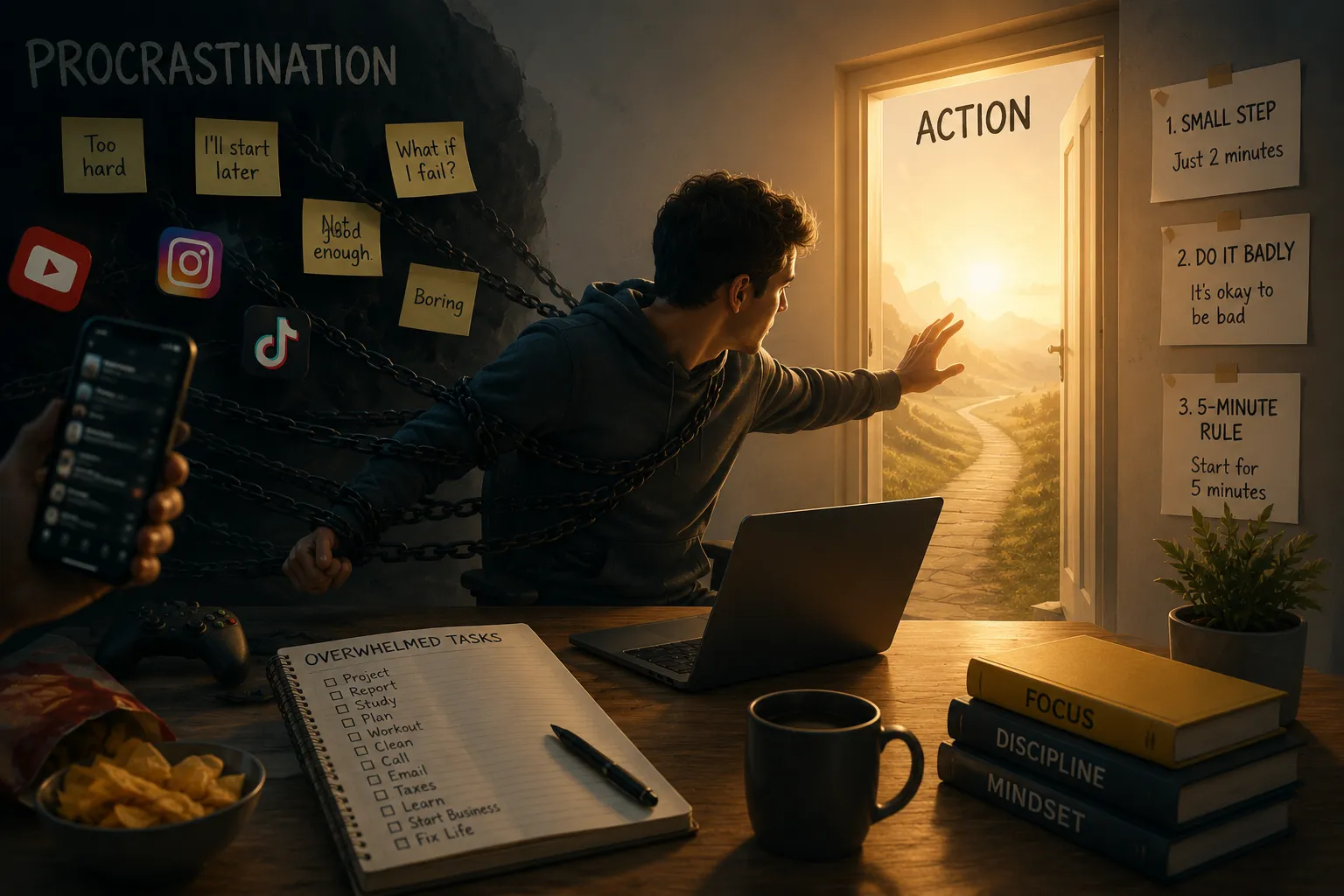
Why You Keep Procrastinating Even When You Really Want To Start
You know that feeling. You sit down to work on something important, and something inside you pulls back. It is not that you forgot. It is not that you do not care. You genuinely want to do it. But your body will not move. Your fingers hover over the keyboard. You open the document, then close it. You tell yourself you will start after one more video, one more scroll, one more cup of coffee. And just like that, another hour is gone.
This is the feeling we left hanging. That invisible force that pulls you away from focus, the same one that makes your mind noisy even in silence. It has a name, and once you see it, you cannot unsee it. But it is not what you think. It is not laziness. It is not a discipline problem. It is something your brain is doing to protect you, and it is working perfectly. That is the problem.
Every Task Has An Emotional Price Tag
Imagine walking into a store where everything is free, but every item has a tag that says how much emotional energy it costs to pick up. A glass of water costs almost nothing. Replying to a simple email costs a little. Starting a big project costs a lot. Having a difficult conversation costs even more.
Your brain reads these price tags constantly. Every time you consider doing something, your mind does a split-second calculation: how much will this cost me emotionally? If the price feels too high, your brain does something remarkable. It refuses to pay. Not because it is lazy. Because it thinks the cost is dangerous.
This is the hidden truth about procrastination. It is not a time management problem. It is not a motivation problem. It is an emotional pricing problem. Your brain looks at the task, sees a huge emotional price tag, and says: “Too expensive. Let’s find something cheaper.” That is why you scroll your phone instead of writing the report. Scrolling is emotionally cheap. Writing is emotionally expensive.
What Makes A Task Expensive
The emotional price of a task is not random. It comes from five specific feelings that your brain treats as warnings. The more of these feelings a task triggers, the higher the price tag climbs.
First, confusion. When you do not know exactly how to start, your brain reads that as a threat. Uncertainty feels unsafe. So it avoids the task entirely. Second, fear of failure. If the task matters to you, failing at it would hurt. Your brain would rather not try than try and fail. Third, perfectionism. When the standard feels impossibly high, just beginning feels like setting yourself up for disappointment. Fourth, boredom. Some tasks feel emotionally dead. Your brain craves stimulation, and a dull task offers none. Fifth, identity threat. If the task is tied to who you want to be, doing it poorly feels like a direct hit to your self-worth.
Most tasks you procrastinate on carry at least two or three of these at once. That is why the price tag feels so heavy. It is not one feeling. It is a stack of them.
Why Discipline Cannot Override The Price Tag
Here is where most productivity advice falls apart. It tells you to push through. Use willpower. Just start. But willpower is like a credit card with a very low limit. You can use it once, maybe twice. But eventually, the card gets declined. Your brain simply will not keep paying a price it thinks is too high.
This is why you can force yourself to start on Monday but completely fall off by Wednesday. It is not because you lost motivation. It is because your emotional credit ran out. You spent it all overriding the price tag instead of lowering the price tag itself.
The real solution is not to force yourself to pay more. It is to make the task cost less. When you lower the emotional price, your brain stops resisting. You do not need willpower to do something that feels safe and manageable. You just do it.
How To Lower The Price Tag
There are three ways to reduce the emotional cost of any task. Each one targets a different feeling on that price tag.
1. Shrink The First Step
Confusion makes tasks expensive because your brain does not know where to begin. The fix is simple: make the first step so small and specific that there is zero confusion. Not “write the report.” That costs too much. Instead: “open the document and type the title.” That costs almost nothing. The trick is that once you take the tiny step, momentum takes over. Your brain realizes the task is not as expensive as it thought, and it keeps going. But you have to start with something ridiculously small. If the first step feels even slightly heavy, make it smaller.
2. Give Yourself Permission To Do It Badly
Fear of failure and perfectionism double the price of every task. Your brain thinks: “If I start this, it has to be good. If it is not good, that means something bad about me.” You can disarm this by telling yourself the opposite before you begin. Say it out loud: “This is going to be terrible, and that is fine.” Give yourself a bad first draft. A messy outline. A rough sketch. The emotional price drops instantly because you are no longer risking your self-worth. You are just making something bad on purpose. And here is the secret: a bad draft you can fix. A blank page you cannot.
3. Set A Five-Minute Timer
Boredom and overwhelm both make tasks feel endless. Your brain hates the idea of suffering through an hour of difficult work. So do not ask for an hour. Ask for five minutes. Tell yourself: “I only have to do this for five minutes. Then I can stop.” This works because five minutes of discomfort is a price your brain is willing to pay. And once you are five minutes in, two things happen. One, the task usually feels less painful than you imagined, so you keep going. Two, even if you stop, you still made progress. Five minutes is infinitely more than zero.
The Real Reason Your Brain Runs
There is something deeper happening here. Your brain does not just avoid expensive tasks. It runs from a specific feeling that lives underneath all of them. It is the feeling of being not enough. Not smart enough to figure this out. Not disciplined enough to follow through. Not good enough to produce something worthwhile. Every time you procrastinate, this is the feeling you are avoiding. Not the task itself. The story the task tells about you.
And this is where it gets dangerous. Because every time you procrastinate, you reinforce that story. You tell yourself “I cannot even start,” and your brain records it as evidence. The next time a similar task appears, the price tag is even higher because now you have a track record of not starting. This is the procrastination loop. Not a habit of delay. A habit of self-doubt that gets stronger every time you avoid.
But There Is A Crack In The Loop
Something strange happens when you finally sit down to work. Even after all that avoidance, even after all that scrolling and delay, the moment you actually start, the fear evaporates. Within minutes, the task feels manageable. The emotional price tag you were so sure was enormous suddenly looks tiny. What changed? The task did not change. You did not suddenly become more disciplined. Something else shifted inside you, something that makes the fear dissolve the moment you cross the threshold.
But most people never get to experience this shift, because something pulls them out just as they are settling in. They start, they feel good for a few minutes, and then their attention
fractures. They check something. They switch tabs. They break their own flow without knowing why. The door opened for a moment, but something keeps slamming it shut.
Why does your brain let you in, only to push you back out? And what is happening in those first few minutes of focus that your brain finds so threatening?

Founder of MindSpaceGlow — I write about intentional living, mindset & productivity for a calmer life. Not a licensed therapist, but sharing practical, research-based tools that work in real life.
More about me →



One Comment