Your Small Room Isn’t the Problem —Your Floor Plan Thinking Is
Everyone tells you to buy smaller furniture and hang mirrors. But the real reason your space feels cramped has nothing to do with square footage — and everything to do with a cognitive bias you’ve never been told about.
I lived in a 280-square-foot studio for three years. I tried every trick in the book — mirrors, multi-functional furniture, vertical shelving, light curtains. My apartment still felt like a waiting room.
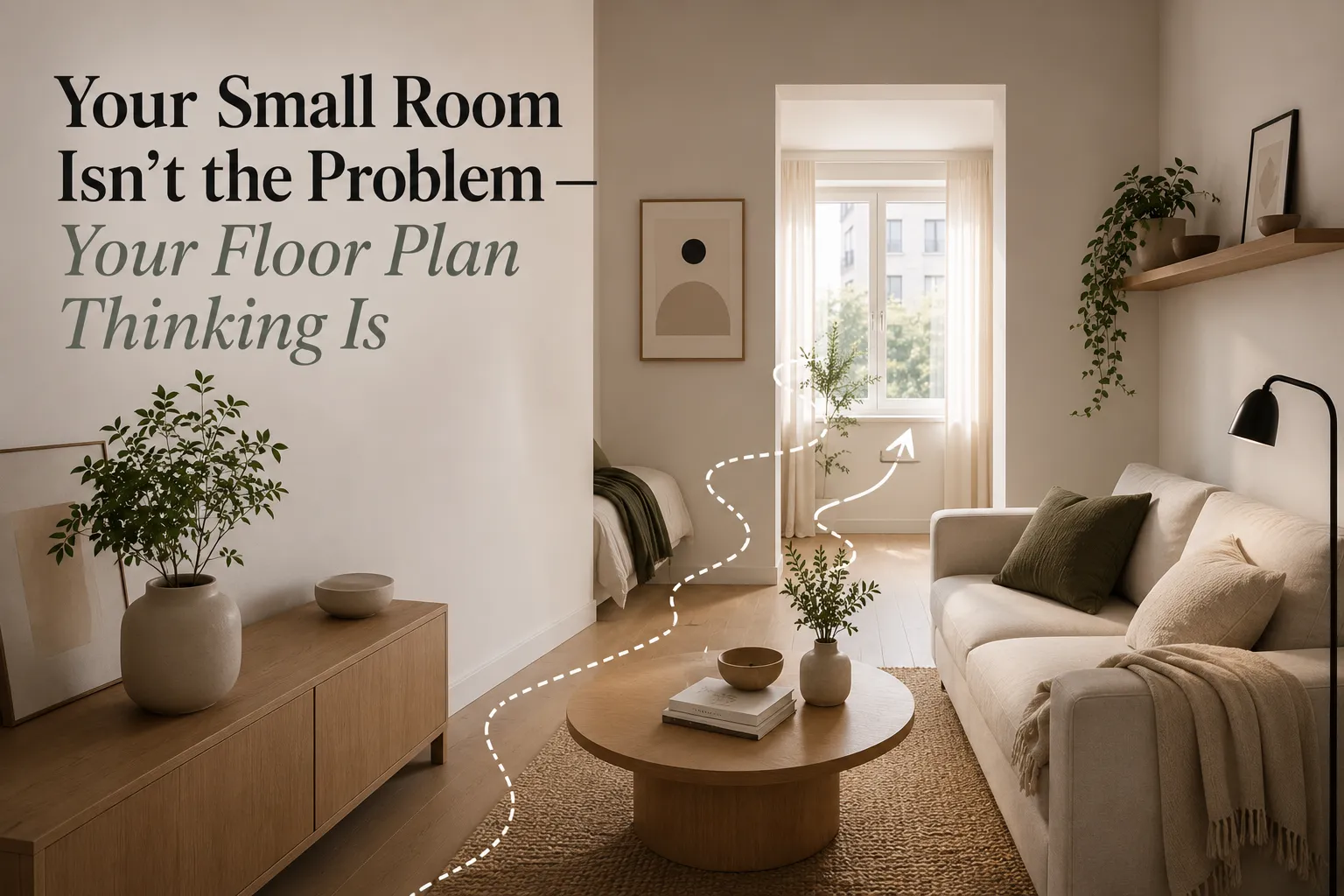
Then an architect friend visited and said something that completely reframed everything: “You’re decorating a floor plan. You should be decorating a sequence of moments.”
That sentence unlocked more space than any IKEA hack ever could. And after diving into environmental psychology and speaking to interior designers who work exclusively with compact homes, I realized the reason most small-space advice fails is that it treats the room as a static object — when you actually experience it as a journey.
§
The Cognitive Bias Making Your Room Feel Smaller
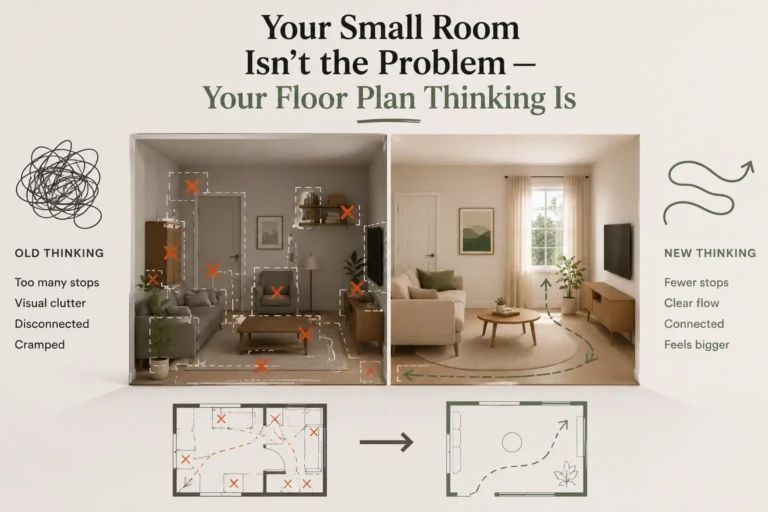
Humans have a hardwired tendency called boundary detection. Our brains constantly scan rooms for visual “stops” — walls, furniture edges, color breaks — and use the number of stops to estimate the size of a space.
More visual stops = brain registers smaller room. Fewer, more deliberate stops = brain registers larger room.
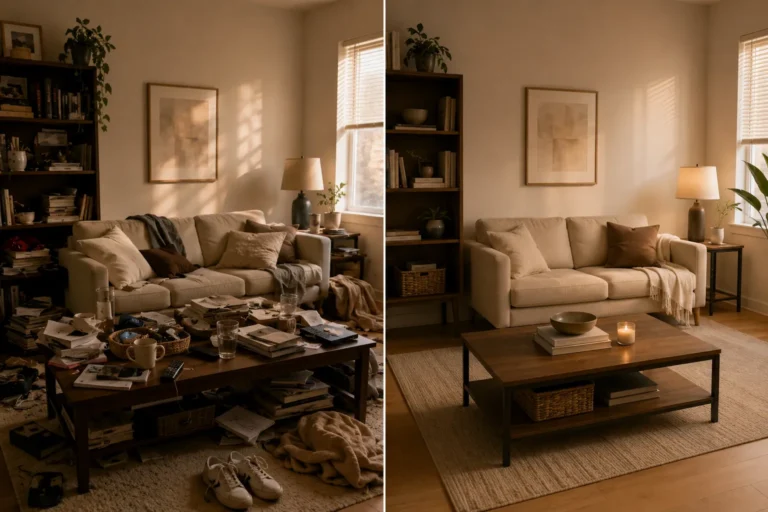
This is why a room crammed with small, cute items can feel far more suffocating than the same room with two or three bold pieces. Your brain isn’t measuring square footage — it’s counting interruptions.
“The brain doesn’t perceive space rationally. It perceives it narratively. If your room tells a fragmented story, it will always feel small.”— Environmental Design Principle, Space Sequence Theory
Most small-space advice accidentally multiplies visual stops. Floating shelves everywhere. Tiny gallery walls. Baskets and bins and decorative objects — each one a little flag the brain has to register. The result: cognitive clutter that reads as physical clutter.
§
5 Unconventional Rules That Actually Work
1. Design One “Rest Zone” for Your Eyes
Every room needs one surface, corner, or wall that is intentionally empty of everything. Not minimalist — empty. A single blank wall. A cleared countertop. An undecorated corner with only light.
This gives your brain a place to exhale. Without it, your nervous system stays in a low-grade state of scanning, which is physically exhausting and makes the room feel smaller than it is. Designers call this “visual breathing room” — but it’s rarely actually practiced because it feels wasteful.
It isn’t. That empty wall is doing the most work in the room.
2. Match Your Biggest Furniture to Your Wall, Not Your Floor
Here’s the one that surprises people most: the color or finish of a large sofa or wardrobe matters far less than its height relative to the wall behind it.
A tall, dark wardrobe against a dark wall disappears. The same wardrobe in a contrasting color against a light wall creates a visual boundary that chops the room in half. This is why rooms with all-white furniture can feel tight — the furniture still contrasts against the floor, breaking the visual flow downward.
The fix: match the dominant surface of your largest piece to the color behind it, not beside it. Let it blend into the vertical plane. Your floor — not your walls — is what should define the room’s boundaries.
3. Use One “Infinity Light Source”
Most people layer multiple light sources — floor lamp, ceiling light, desk lamp, LED strips. This creates beautiful ambiance but also creates multiple competing focal points that fragment the space.
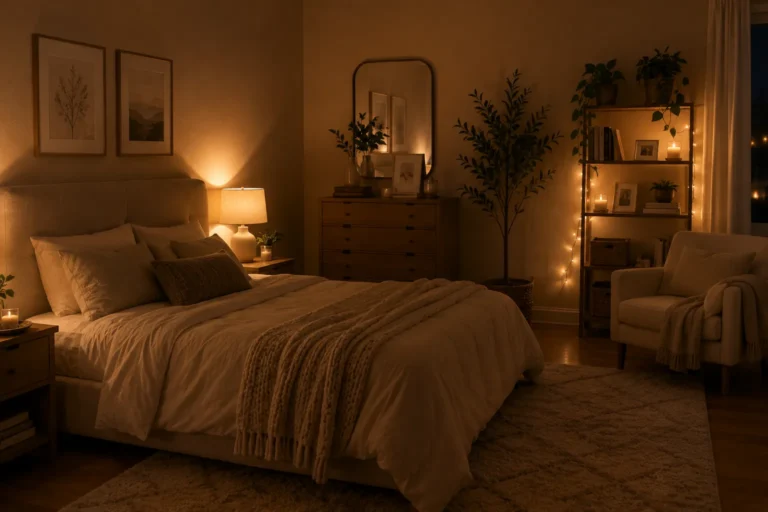
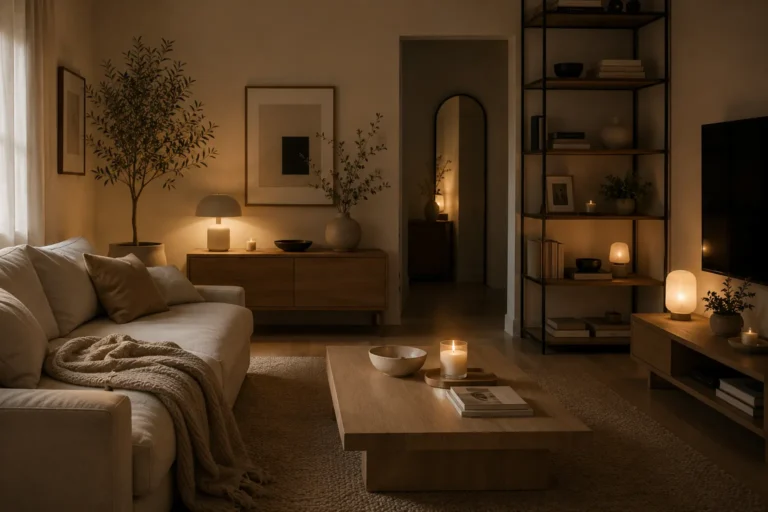
Instead, anchor your main light source behind or beside a large surface: inside a bookshelf, behind a headboard, beneath a floating console. When light comes from within a surface rather than above it, the room loses its hard edges at night and feels dramatically larger.
This is how hotel rooms in compact Tokyo apartments create that expansive, cinematic feeling that photos can never fully capture. It’s not the size. It’s where the light is hiding.
4. Let One Object Be Deliberately Oversized
The common advice is: small room, small furniture. This is categorically wrong.
One oversized object — a large-scale artwork, an unexpectedly big pendant light, a generous armchair — acts as a spatial anchor. It gives the brain a clear hierarchy: one main thing, everything else secondary. This actually makes the room feel larger because the brain registers scale contrast rather than uniform smallness.
A room where everything is small feels like a dollhouse. One big thing makes it feel like a room where a big thing can fit.
Quick Reference: The Stop-Count Test
- Stand in the doorway of your room and count every distinct object your eye “lands on” in 5 seconds.
- If the count is over 12 → your room has too many visual stops.
- Target: 5–8 intentional resting points, not more.
- Remove or group small objects until you hit that range. The room will feel noticeably larger within minutes.
5. Treat Your Floor Like a Canvas, Not a Carpet
The floor is the largest continuous surface in any room — and most people cover it in ways that break it into zones: a rug here, a mat there, a runner by the door. Each piece creates a boundary your brain reads as a wall.
Instead, choose one large rug that covers 80% of the floor, or remove rugs entirely and let the flooring run continuously. When the floor reads as one uninterrupted surface, the room’s footprint suddenly feels intentional rather than accidental.
If you love the warmth of a rug, go bigger than feels comfortable. The oversized rug that seems like too much on paper almost always feels right in real life — because it eliminates stops rather than creating them.
§
A Simple 20-Minute Reset You Can Do Today
You don’t need new furniture. You need a new editing session. Here’s a sequence that takes under 20 minutes and produces immediate results:
- Remove everything from one surface entirely.One shelf, one table, one counter. Leave it empty for 48 hours and notice how the room changes.
- Group all small decorative objects into clusters of three.Three items together register as one visual stop instead of three. You didn’t remove anything — you just reorganized how the brain counts.
- Push all furniture 2–3 inches away from the wall.This sounds backward but it works: a tiny gap between furniture and wall creates depth. Objects pressed flat against walls look like wallpaper, not furniture.
- Cover or remove one light source.Go from three competing sources to two. Notice if the room feels more cohesive.
- Identify your one oversized anchor.If you don’t have one, a large framed print — even a simple one — placed at eye height on your main wall costs almost nothing and changes everything.
§
What Nobody Tells You About “Cozy” vs. “Small”
There’s a meaningful difference between a room that feels cozy and a room that feels cramped — and the line between them is almost entirely about intentionality.
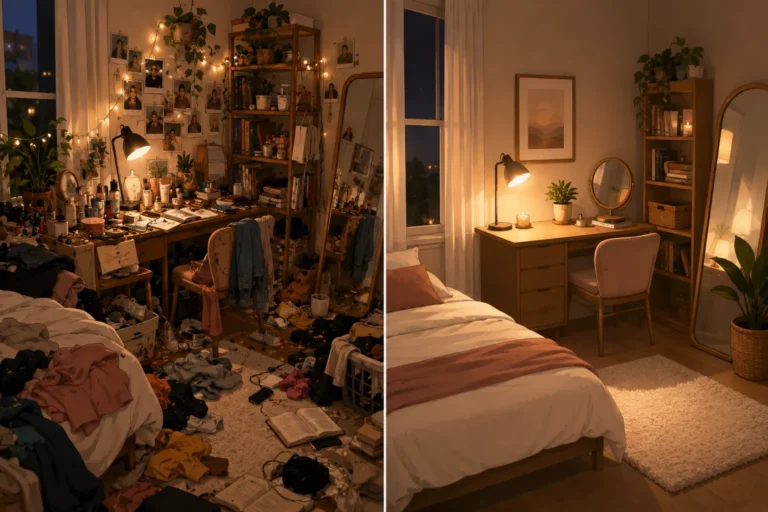
Cramped means: stuff everywhere, no clear hierarchy, the eye has nowhere to rest. Cozy means: warmth and presence, but the eye knows where to go and the brain isn’t working hard to process the room.
You can achieve cozy in 280 square feet. What you can’t achieve is cozy-while-cluttered — because those two things are neurologically incompatible. The brain reads visual noise as stress, not warmth.
The single fastest way to make a small room feel cozy rather than cramped: remove 30% of the objects in it and add one warm, diffused light source. That’s it. The warmth isn’t coming from more stuff — it’s coming from the space around the stuff you love.
The Bottom Line
Small spaces don’t need more solutions. They need fewer, better ones. The most transformative thing you can do for a compact room isn’t buying a new piece of furniture — it’s understanding that your brain doesn’t measure rooms in feet. It measures them in decisions.
Every object is a decision your brain has to make. Every cluttered surface is a small tax on your mental energy. Every empty corner is a gift to your nervous system.
You don’t need a bigger apartment. You need to stop fighting your floor plan — and start designing a sequence of moments that your brain wants to move through.
That’s the real magic of small spaces. It was never about the square footage.
Try the Stop-Count Test Tonight
Stand in your doorway, count your visual stops, and edit down to 8. Most people say it’s the most impactful 10 minutes they’ve spent on their home — for free.

Founder of MindSpaceGlow — I write about intentional living, mindset & productivity for a calmer life. Not a licensed therapist, but sharing practical, research-based tools that work in real life.
More about me →