Why Your Organized Home Still Feels Chaotic (And the 15-Minute Fix Nobody Talks About)
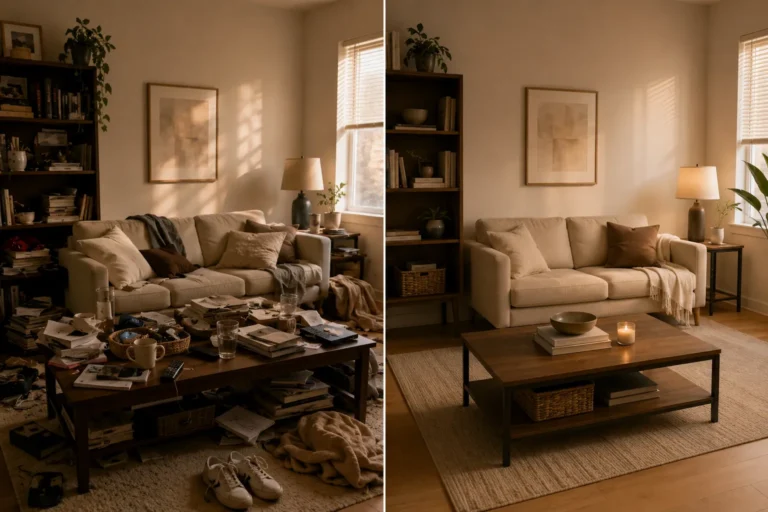
You bought the storage bins. You labeled everything. You watched all the videos. And yet your home still feels stressful to be in. The problem is not your system. It is something that happens before the system even starts.
My kitchen was perfectly organized once. Every drawer labeled. Every container matching. Every utensil with a designated spot.
It still felt chaotic. I could not figure out why until a professional organizer told me something I have never forgotten: “You organized for storage. You should have organized for motion.”
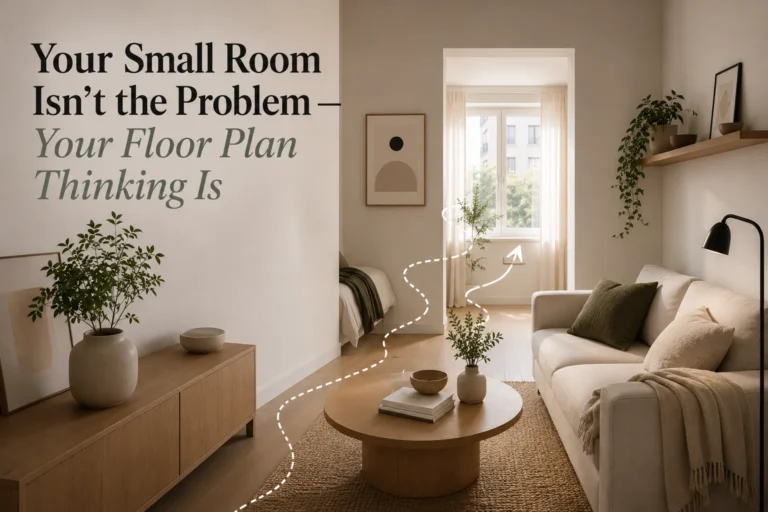
Most organizing advice is about where things live. Very little of it is about how things move. And the difference between those two ideas is the difference between a home that feels calm and one that stays stressful no matter how many baskets you buy.
The Real Reason Organized Homes Feel Messy
There is a concept in professional organizing called friction cost. It refers to the number of steps required to put something away or get it out again.
Every extra step is a small tax. Open a cabinet, move a box, lift a lid, find the item, replace everything in reverse. If the friction cost is high enough, people stop using the system. Things pile up outside their designated homes. The room looks chaotic again within days of being organized.
This is why beautifully designed storage solutions often fail in practice. They look perfect and work terribly. Anything that requires more than two steps to access is unlikely to be used consistently. And anything that requires more than two steps to put away will end up on the nearest flat surface instead.
“The best organizing system is the one you will actually use. That almost always means the simplest one, not the most beautiful one.”Professional Organizer, NAPO Certified
§
Organizing for Motion, Not Storage
When you organize for motion, you ask a different question. Instead of “where should this live?” you ask: “Where does this naturally end up, and how can I make that the right place?”
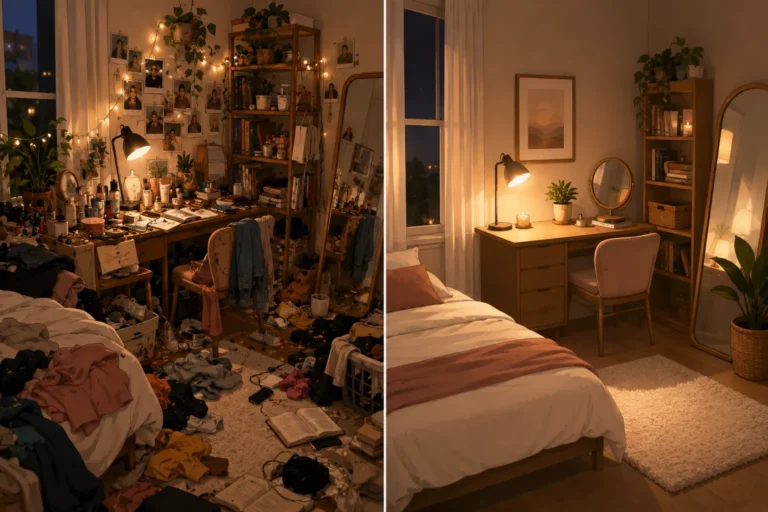
Watch yourself for one week. Notice where things pile up. Your keys probably land in the same three spots. Your mail collects in a consistent place. Your shoes end up near the same door. These spots are not signs of disorganization. They are data. Your home is telling you where things want to live based on how you actually move through it.
The most effective organizing move you can make is to put storage exactly where the piles already form. A small tray near the door where keys always land. A hook in the hallway where the bag always drops. A magazine holder in the exact spot where reading material accumulates.
When the storage is where the pile forms, the friction cost drops to nearly zero. The item is already in the right place. You are just making that official.
The 15-Minute Fix
This is the exercise that changes how most people think about their homes. It takes 15 minutes and you need nothing except a notepad or your phone.
- Walk through your home and write down every pile.Not to judge them. Just to note where they are. Shoes by the door. Papers on the kitchen counter. Charging cables on the nightstand. List every spot.
- For each pile, write what it actually contains.Most piles are consistent. The kitchen counter pile is almost always mail, small packages, and things that need attention. The bedroom chair pile is almost always clothes that are clean but not ready to be put away.
- Ask one question for each pile: can I make this pile official?Can I put a tray here? A hook? A small basket? Something that holds the pile while making it look intentional?
- Act on two of them this week.Not all of them. Two. A small tray costs less than five dollars. A hook costs three. You are not reorganizing. You are accepting the truth of how your home works and designing with it.
The rooms that stay calm are not the rooms where people fight their natural habits. They are the rooms where the design works with those habits instead of against them.
The Three Organizing Mistakes Most Guides Miss
Mistake One: Organizing Things You Should Remove
The most common organizing mistake is spending time creating a home for something that should not be in the house at all. Expired medications with a labeled bin. Cables for devices you no longer own in a sorted drawer. Clothes that do not fit in a color-coded section of your wardrobe.
Before you organize anything, spend ten minutes with a trash bag. Walk through one room and remove anything broken, expired, unused in over a year, or kept purely out of guilt. The volume of stuff is the first problem. The system is the second. Trying to fix the second before the first is why systems always feel temporary.
Mistake Two: Organizing Zones Nobody Uses
High shelves, deep cabinets, and the backs of closets are storing things you will never find again. These zones should hold only seasonal items, long-term storage, or things you actively choose to keep out of daily life. Putting frequently used items in hard-to-reach places creates the feeling of a cluttered home even when everything technically has a spot.
The rule is simple: the more often you use something, the closer to eye level and arm’s reach it should live. Daily items go in the front, at shoulder height. Weekly items go slightly further. Monthly items go to the back or high shelf. Yearly items go to storage.
Mistake Three: Matching Containers Over Function
Matching bins and baskets look beautiful on social media. In real life, they are often the reason systems fail. When every container looks the same, people stop seeing them. The visual sameness means nothing stands out, so the eye cannot quickly find what it needs. The result is that people stop putting things away properly because the system requires too much mental effort to use.
A small color difference, a height difference, or even a different material for your most-used storage categories is more useful than a perfectly matched set. The goal is legibility, not aesthetics.
The organizing rule worth memorizing: if you cannot find it in under 10 seconds, it does not have a good enough home yet. Not a bigger label. Not a better container. A more obvious location.
The One System That Works in Every Home
After all the complexity, the organizing approach that consistently works comes down to one idea: everything visible should be intentional, and everything stored should be findable in under ten seconds.
Visible means on a surface, on a shelf, or hanging on a wall. If it is visible, it should be there because you want to see it. Not because there was nowhere else for it to go.
Findable in ten seconds means the location is logical, the path to it has low friction, and you would be able to describe where it is to someone else in one sentence.
That is the whole system. Two rules. No bins required.
This Week’s Organizing Checklist
- Identify your three biggest recurring piles and make them official with a tray or basket
- Spend 10 minutes removing things that should not be in the home at all
- Move your five most-used items to a more visible, closer location
- Check one cabinet or drawer: can you find anything in it in under 10 seconds?
- Ask yourself: am I organizing for storage, or for how I actually move?
What a Calm Home Actually Feels Like
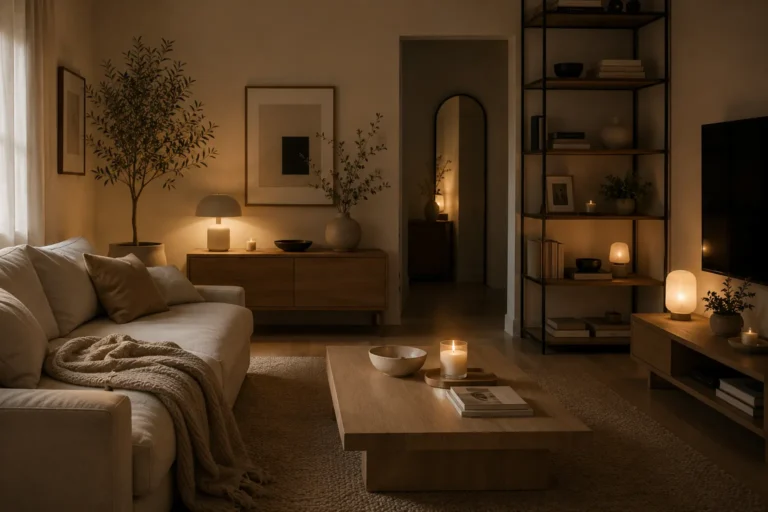
A calm home is not a spotless home. It is a home where your eye knows where to rest and your hands know where things are. It is a home where the daily rhythm of moving through it produces no friction and no small stresses.
That feeling does not come from perfect organization. It comes from honest organization. A system that works with your real habits instead of the habits you wish you had.
Your home is already telling you what it needs. The piles are the clues. You just have to start listening to them instead of fighting them.
Do the 15-Minute Walk Tonight
Grab your phone, walk every room, and write down every pile. You will know exactly what to do next before you finish the list.

Founder of MindSpaceGlow — I write about intentional living, mindset & productivity for a calmer life. Not a licensed therapist, but sharing practical, research-based tools that work in real life.
More about me →