Why Your Room Feels Cold at Night (And the 10-Dollar Fix)
Your room looks perfect by day but feels cold and flat at night. The hidden reason is your ceiling light. Learn the warm glow trick that fixes it for under ten dollars.
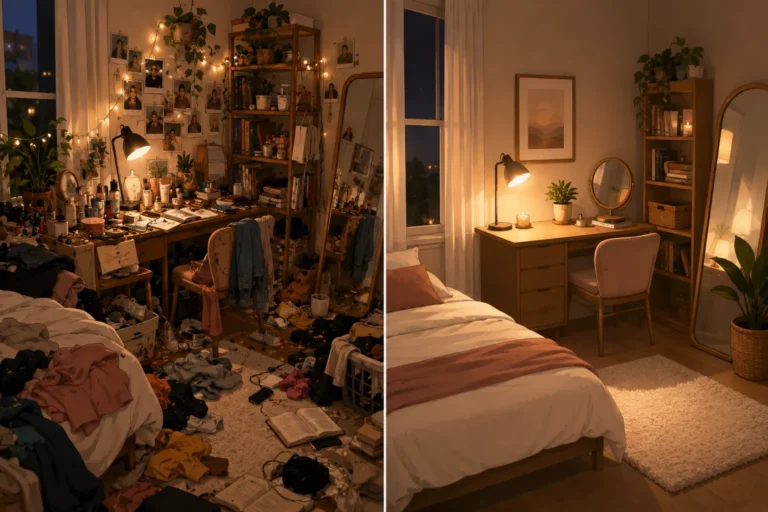
You finally did it. You cleared every surface, consolidated the colors, and stripped away the busy patterns. Your room looks like the calm, clean space you always wanted. Daylight pours through the window and everything feels right. Then the sun drops, you flip the switch, and the whole room collapses. That same space that felt so open and warm an hour ago now feels cold, flat, and oddly lifeless. The furniture is the same. The walls are the same. You did not add or remove anything. So what just happened?
Your Ceiling Light Is Erasing the Room
The hidden reason your room feels cold at night has nothing to do with your decor and everything to do with the way your brain reads light. During the day, sunlight enters from the side, through windows. It skims across surfaces, catches the edge of a table, casts soft shadows under a shelf, and creates gentle gradients of brightness across the floor. Your brain loves this. It uses those shadows and brightness shifts to understand depth, texture, and warmth. Side light tells your brain: this room has dimension, this surface is real, this space is alive.
But the moment you flip on your ceiling light, everything changes. Ceiling light comes from directly above. It hits the top of every surface evenly and floods the room with flat, uniform brightness. Shadows vanish. Gradients disappear. Every wall gets the same wash of light from top to bottom. Your brain loses all the depth cues it was using to feel the space. It is like someone took a photograph of your room and turned the contrast all the way down. The room is still physically there, but your brain cannot feel it anymore. That flat, lifeless sensation is what you are calling cold.
Why Adding More Lights Does Not Help
If you have ever searched for lighting advice, you have probably seen the tip: just add a lamp. So you bought a lamp, put it in the corner, turned it on alongside your ceiling light, and waited for the cozy feeling to arrive. It did not. The room still felt off, just brighter. Here is why. Adding a lamp on top of your ceiling light is like turning up the volume on a song that is already playing in the wrong key. You are adding more light, yes, but you are not changing the quality of the light. The ceiling is still flooding the room from above, and the tiny lamp underneath cannot compete with that overhead wash.
Your brain does not measure comfort by how bright a room is. It measures comfort by the direction and variety of light. A single candle in a dark room feels infinitely cozier than four blazing ceiling lights in the same room, because the candle creates shadows, gradients, and a focal point. Your brain reads those shadows as depth. It reads that single warm glow as a gathering point, like a campfire. The four ceiling lights erase every shadow and leave your brain with nothing to hold onto.
How Your Brain Reads Shadows as Comfort
Think about the coziest room you have ever walked into. A cabin with a fireplace. A reading nook with a small window. A restaurant with candles on every table. What do all of those spaces have in common? They are not bright. They are layered. There are pockets of warm light and pockets of darkness sitting right next to each other. Your brain reads that contrast the same way it reads a hug. The bright spot pulls your attention, and the surrounding shadow wraps around you. Without the shadow, the light has no shape. Without the light, the shadow has no warmth. They need each other to create the feeling of comfort.
This is why your room feels cold at night even though it is technically well-lit. The ceiling light killed every shadow. It flattened the space. Your brain is searching for the contrast between light and dark that tells it “this room has depth, this corner is safe, this space is holding me,” and it is finding nothing. Just an even, clinical brightness that belongs in an office, not a bedroom.
The Shadow Layer Method: Your 10-Dollar Fix
You do not need new fixtures, rewiring, or an electrician. You need to introduce one shadow back into the room tonight, and it costs less than a pizza. Here is the Shadow Layer Method. Step one: turn off your ceiling light completely after sunset. Yes, completely. It is not helping you. It is the thing making your room feel cold. Step two: take one lamp, any lamp you already own, and place it at roughly the height of your head when you are sitting down. A bedside table, the edge of a desk, a shelf at eye level. Step three: put a warm-toned bulb in it. Look for a label that says 2700K or “warm white.” If you do not have one, a standard soft white bulb from any dollar store will get you close enough.
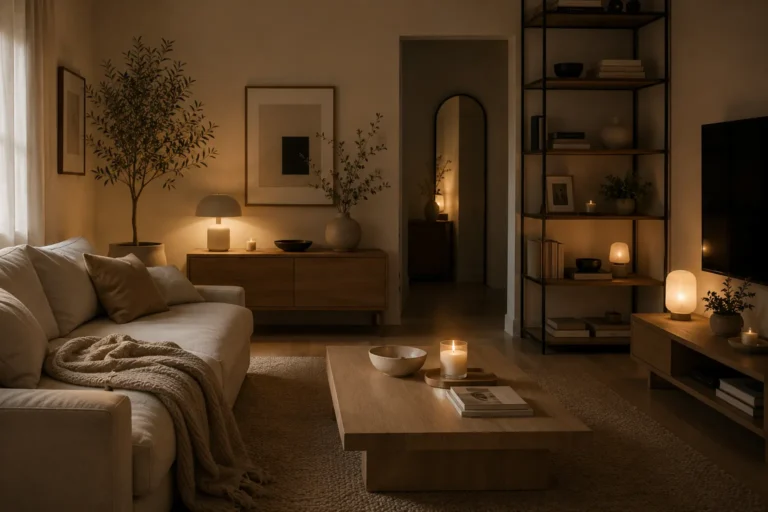
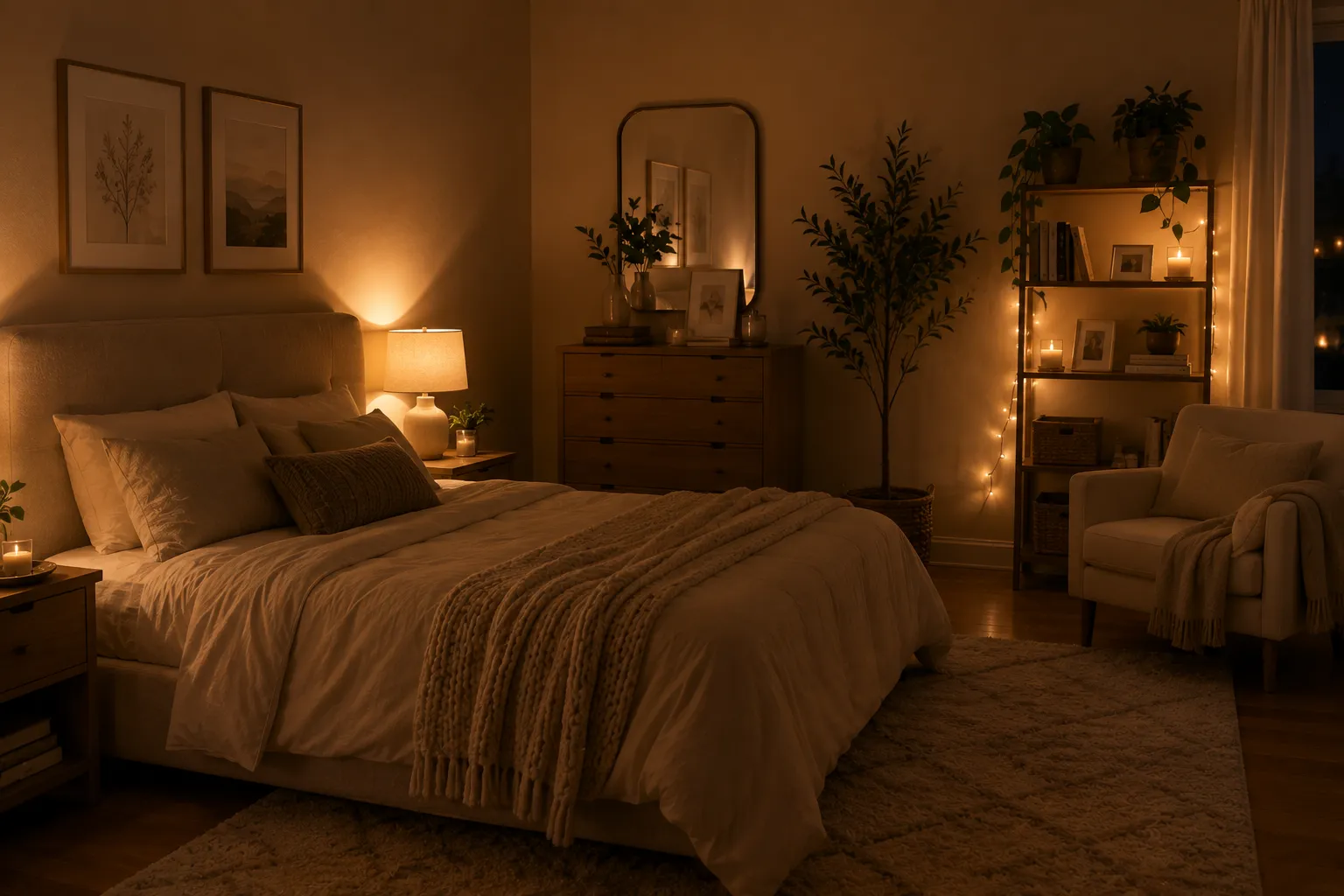
Now sit in the room with only that one lamp on. Notice what happens. The area around the lamp glows warm and inviting. The corners of the room fall into soft shadow. Your brain immediately starts reading depth again. The wall behind the lamp gains a subtle gradient.
The table surface catches a warm highlight while the area underneath falls into shade. In thirty seconds, your room went from flat and cold to layered and cozy, and you spent zero dollars if you already had a lamp, or about eight dollars if you needed a warm bulb.
Adding a Second Glow Point
Once you feel the difference that one shadow layer makes, you can deepen the effect with a second glow point on the opposite side of the room. It does not need to match the first lamp. In fact, it works better if it is smaller and dimmer. A string of fairy lights draped over a shelf. A small plug-in nightlight tucked behind a plant. Even the screen of a laptop propped open on a dim setting. The goal is not to light the whole room. The goal is to give your brain two warm points to rest between, like sitting between two campfires. The space between them naturally feels held and sheltered.
The most common mistake people make with this second layer is placing it too high. If both light sources are above your head, you are recreating the ceiling light problem in miniature. Keep the second glow low, below shoulder height when you are seated. This mimics the way firelight works, and your brain is hardwired to interpret low, warm light as safety.
The Warm Bulb Rule
One final note. If your lamp currently has a “daylight” or “cool white” bulb in it, swap it before you try any of this. Cool white bulbs emit light in the 4000K to 5000K range, which mimics overcast noon light. Your brain associates that color with alertness, productivity, and being outdoors. Warm bulbs at 2700K mimic the color of fire and sunset. Your brain associates that color with winding down, feeling safe, and staying still. The wrong bulb color can undo every other lighting trick you try, so this single swap is the highest-impact change you can make tonight.
The Question That Comes Next
You killed the ceiling light. You added a warm glow at eye level. Maybe a second one across the room. Your room finally feels cozy at night. The shadows are back, the depth is real, and your brain is finally at ease. But there is one thing that still nags at you. The room feels cozy now, but it still feels small. The walls feel closer than they did this morning. The corners seem to have crept inward overnight. You fixed the light, you fixed the clutter, so why does your room still feel like it is shrinking? The answer is hiding in something you have probably never thought to check: the distance between your furniture and the walls.

Founder of MindSpaceGlow — I write about intentional living, mindset & productivity for a calmer life. Not a licensed therapist, but sharing practical, research-based tools that work in real life.
More about me →